

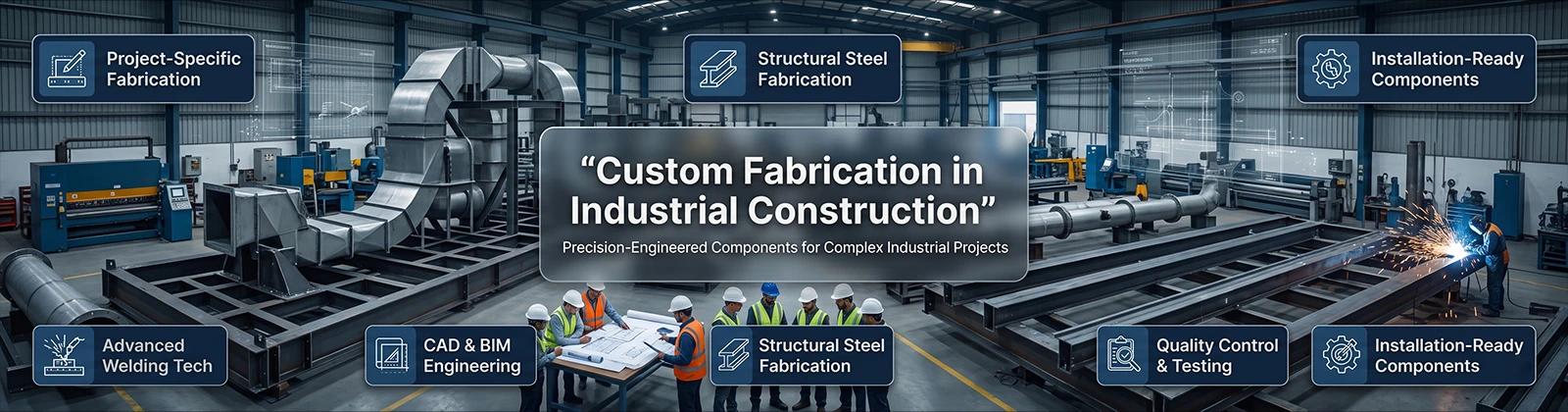
Industrial projects rarely conform to conventional components. Each facility has a distinct design, expected load requirements, and operational conditions that generic parts cannot meet. This is where the concept of custom fabrication in industrial construction comes into play since every component is constructed according to the specific criteria of the project regardless of whether they are ventilation systems (duck work and piping) or structural supports
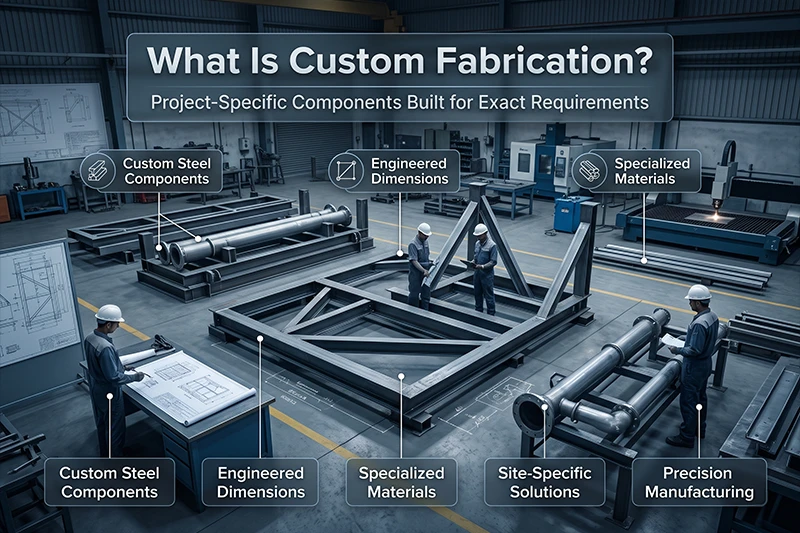
What is a Custom Fabrication in Industrial Construction
Custom fabrication is the process of designing, cutting, shaping, and assembling parts used for a project according to its requirements, rather than using commercially manufactured components. Commonly used materials in this process include steel fabrication for industrial projects steel, stainless steel, aluminum, and other kinds of alloys, which are selected depending on the requirements relating to the structure, heat, and chemicals encountered at the facility.
Unlike prefabricated components, which are manufactured according to some standard measures, custom-fabricated parts are designed with an eye for the conditions on the site and the equipment they need to support. Additionally, quality industrial fabrication service companies such as HLK Infra combine the necessary engineering skills with manufacturing experience to create components accordingly.
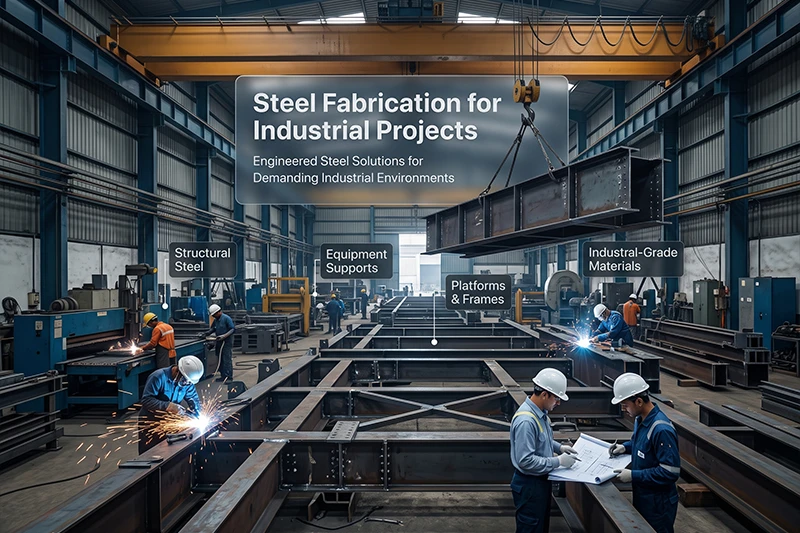
Why Custom Fabrication Matters in Industrial Projects
- Precision Fit for Complex Facilities – Industrial plants frequently have strange layouts, limited space, or equipment with unconventional measurements. Custom fabrication guarantees that pieces will fit exactly as they should and will not need to rely on standard parts.
- Performance Under Site-Specific Conditions – Each Industrial plant deals with different ranges, temperatures, and exposure conditions. With custom fabrication, components can be designed specifically, taking local conditions into consideration rather than built as standard.
- Regulation and Code Compliance – Industrial construction fabrication is subject to strict safety regulations and codes. Custom fabrication makes it possible to create and test components according to the exact requirements of the project.
- Elimination of Reworks and Delays – If components are fabricated according to the specific requirements of the project, there will be no need for rework on site, which consequently would help to avoid delays in the project.
- Long-Term Durability and Maintenance Efficiency – A properly fabricated part designed specifically for the intended environment is generally expected to last longer, with less maintenance over the facility lifecycle.
Common Application for Custom Fabrication in Industrial Construction
Custom fabrication appears in almost all of the systems inside an industrial facility. It encompasses the ductwork and functions of HVAC, structural steel and systems for support, piping with skids, and platforms with various kinds of machinery. In the construction industry, HLK Infra, which is also one of the custom fabrication companies, has made great progress, especially in manufacturing ductwork combined with mechanical fabrication intended for industrial HVAC systems.
Step-by-Step Custom Fabrication Process
Effective project management in custom fabrication is all about following set protocols to guarantee precision, quality, and timely delivery. At HLK Infra, custom metal fabrication contractor, the entire process usually comprises the following steps:
Step 1: Site Evaluation and Requirement Collection – Initially, site evaluation is carried out while thoroughly noting the project requirements such as dimensions, specifications, and operational requirements.
Step 2: Creation of Designs and Engineering Drawings – Once requirements are clear, detailed designs or drawings are made using tools such as CAD or BIM based on the previous step.
Step 3: Choosing and Sourcing Materials – The right materials are chosen as per the project’s scope and specifications. Materials are then sourced from verified suppliers
Step 4: Fabrication and Machining – Once the materials are procured, fabrication and machining work are started. Components are manufactured in compliance with adequate drawings and dimensions along with tolerances.
Step 5: Quality Control and Testing – Every manufactured element is subjected to quality control, where necessary testing is done to check dimensions, as well as workmanship, materials, and other aspects that involves in the execution of the project.
Step 6: Final Delivery and Installation Support – Once approved, the processed parts are prepared for delivery to the project site and provided with the necessary support during installation.
By following this systematic approach for custom fabrication construction, HLK Infra has managed to minimize errors, guarantee quality, and keep contracts on schedule, delivering reliable and accurate engineered fabrication solutions.
Essential Factors to Consider When Choosing a Custom Fabrication Partner
Selecting the appropriate partner for custom fabrication is critical in ensuring quality, compliance, and timely execution of the projects. The following four critical factors should be considered:
- Engineering and Designing Capabilities – In order to select a fabricator, choose a strong in-house engineering capabilities, that can accurately prepare CAD/ BIM designs and offer sound fabrication options.
- Manufacturing Capacity & Material Quality – The contractor should have sufficient machinery, equipment and capability to perform fabrication on an industrial level while keeping the quality of the work consistent.
- Standards & Code Compliance – Ensure that the vendor complies with the relevant standards in the industry such as ISO and ASME, as well as the local codes and regulations, including those for safety.
- Time Management and Coordination – The right fabrication partner should be able to comply with deadlines and manage production, as well as coordinate with other teams during the delivery and on-site installation process.
HLK Infra brings together engineering expertise, manufacturing capabilities, quality sourcing, and compliance partners for all industrial fabrication services.
Custom Fabrication and Standard Fabrication
Both Custom Fabrication and Standard Prefabrication play different roles. While standard prefabricated components work well for simple, repeatable applications, Custom fabrication becomes necessary once a project involves unique layouts, specialized equipment, or demanding performance requirements.
Factors | Standard Prefabrication | Standard Prefabrication |
Application | Best for simple, repeatable applications
| Ideal for complex and specialized projects |
Design | Uses standard sizes and configurations | Designed and manufactured to project-specific requirements |
Flexibility | Limited Customisation | High flexibility to unique designs and layouts |
Cost & Time | Generally faster and more cost-effective | Requires more engineering, time, and investment |
Precision | Suitable for predictable dimensions and conditions | Provides precise fit and project-specific dimensions |
Performance | Works well for standard operating requirements | Better suited for demanding industrial environments |
How HLK Infra Supports Custom Fabrication for Industrial Projects
HLK Infra brings together its engineering skills with fabrication knowledge and experience so that companies can have one point of contact for custom parts. The work of the team includes HVAC, metal fabrication, and structural fabrication plus an ongoing commitment to high quality and necessary compliance. HLK Infra will work together with the client’s project team and MEP teams, making sure to follow their guidelines smoothly throughout the project. There are many large industrial buildings that HLK Infra can help with from the moment of the design stage till the installation.
Conclusion
In conclusion, custom fabrication remains vital to industrial construction. Custom fabrication guarantees that every component produced not only fits perfectly to satisfy its function under actual working conditions but also meets the safety standards required by industrial projects. By working with a reliable fabrication partner, the amount of rework decreases dramatically, and adherence to schedule becomes much easier. If interested in custom fabrication services for your future industrial project, reach out to HLK Infra.
Questions People Frequently Ask
Custom fabrication is the process of creating production components for a specific project in accordance with its unique conditions and requirements rather than conventional components.
The principal difference is that prefabrication is based on standardized production processes, whereas custom fabrication is based on custom design.
Manufacturing, HVAC, energy, and heavy industrial sectors frequently rely on custom fabrication for specialized equipment and structures.
Custom fabrication differs in time frames depending on the complexity of the solution but generally takes longer as design is involved.