

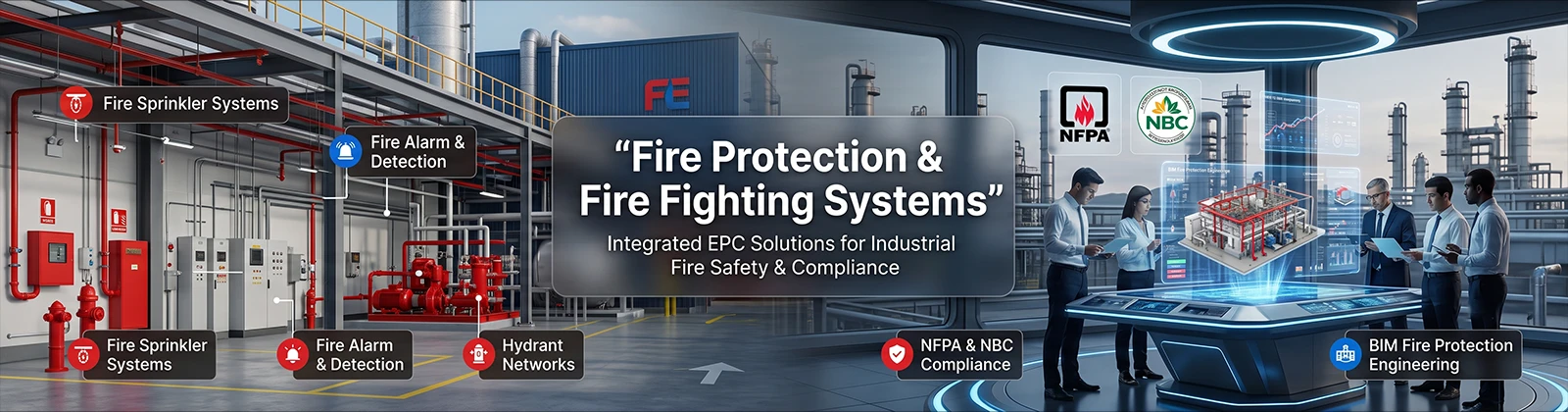
Fire safety is a vital part of any EPC project; however, it can never be an afterthought because poor fire protection systems can result in numerous risks related to compliance issues, property loss, operational downtimes, and even to some extent threats to human life.
To avoid risking all the above-mentioned things, the only way out is to incorporate Fire Protection and Fire Fighting Systems in EPC Projects, starting from the EPC design stage and continuing until the construction stage. This will ensure a higher level of safety, easier compliance, and quicker execution of the EPC process.
HLK Infra follows the principle of introducing fire protection from the very start of all of the projects, and this guide aims to provide an overview of fire protection systems, their significance for EPC projects, as well as methods of their design, installation, and testing and shed some light on why HLK Infra is regarded as a highly reliable contractor in fire protection and firefighting sphere in EPC projects.
What are Fire Protection and Fire Fighting Systems?
Fire protection and firefighting are usually termed together, but they carry different purposes.
- Fire Protection:There are two types of Fire Protection Systems in EPC projects, passive fire protection and active fire protection. Passive fire protection is a method that minimizes fire spread with the help of special materials, doors, and walls that belong to the category of fire-rated items, while active fire protection and its systems react to a fire directly. For example, sprinkler systems.
- Firefighting: Fire Fighting Systems are the things that are used in order to extinguish fire. In this group of systems, we can specify such as hydrants, hose reels, and pumps.
- Fire Detection System: The aim of Fire Detection Systems is to recognize a fire before it occurs. As a result, this method should be employed with the use of smoke detectors and heat sensors.
- Fire Suppression Systems stop the fire directly. Gas suppression and clean agent systems are very common in some sensitive spots, for example, in data centers.
These different types of systems are also significant for the functioning of EPC projects. They are important in design, procurement, installation, and commissioning processes as well.
Importance of Fire Safety in EPC Projects
- Protecting Human Lives: The fundamental aim of every fire protection system is to provide security towards humans. Timely detection along with rapid reaction minimises the chances of injuries or deaths.
- Limiting Damage to Property: A sound fire protection system prevents the advancement of flames. This helps in protecting the structure, machines, and important equipment away from heavy losses.
- Ensuring Adherence to Regulations: The National Building Code (NBC), NFPA standards and IS Codes along with local fire safety regulations must be complied with. HLK Infra designs systems in accordance with the standards mentioned in the law.
- Minimising Downtime: Properly designed industrial firefighting systems to eliminate interruptions at work. This allows companies to resume their work quickly after the incident.
- Decreasing Risk and Insurance Costs: Good fire protection systems lead to minimisation of losses as well as proper insurance compliance.
Major Components of Fire Protection Systems
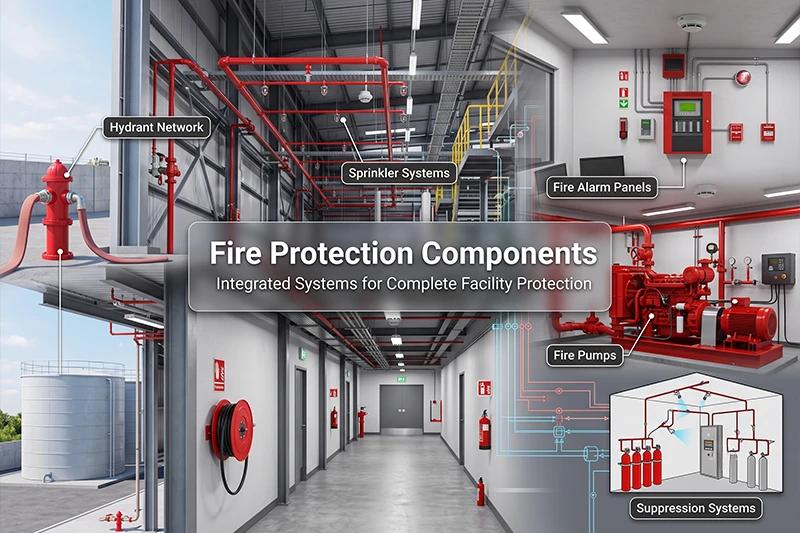
A comprehensive fire protection system in the EPC projects often include many parts with each serves specific purpose
- Fire Hydrant System – Provides a dependable water supply for emergency response across a facility.
- Automatic Fire Sprinkler System – Activates automatically when heat is detected and controls fires before they spread.
- Fire Alarm and Detection System – Fire alarm system in EPC projects, detects smoke or heat and alerts occupants and staff the moment the fire is sensed.
- Fire Pumps – Maintain adequate water pressure during emergencies needed for hydrants and sprinklers.
- Fire Water Storage Tank – Stores sufficient water for firefighting operations.
- Hose Reel System – Enables quick manual access for firefighting teams and staff.
- Fire Extinguishers – Provide immediate responses for small fires.
- Smoke Detection System – Detects smoke at the earliest stage before the fire spreads.
- Emergency Exit and Evacuation Systems – Guide occupants safely out of the building, ensuring safe evacuation during emergencies.
- Clean Agent Fire Suppression Systems – Protect sensitive equipment such as electronics without water damage.
- Gas Suppression Systems – Suppress fire using inert or chemical gases, ideal for electrical rooms and data centres.
- Foam Fire Protection Systems – Used for flammable liquid fires, common in industrial plants.
HLK Infra, one of the top EPC contractors, designs and integrates all of these components as one coordinated system.
Firefighting System Design Process in EPC Projects
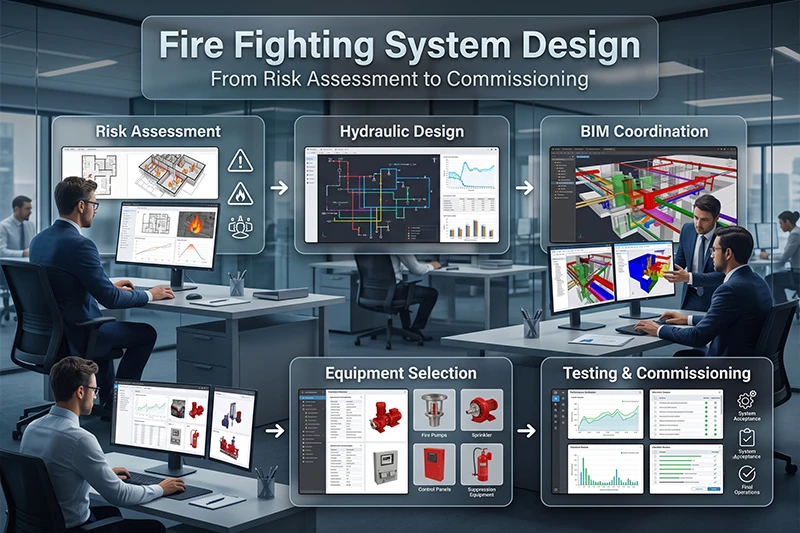
An effective firefighting system design requires a systematic approach. Here are the steps for a successful firefighting in the EPC project:
- Risk Assessment – Engineers evaluate the space being designed and calculate fire loads with the ultimate aim of recognizing the risks. This sets the stage for the correct design.
- System Design – Hydraulic calculations, equipment sizing, and pipe routing is critical in achieving successful system performance.
- BIM Coordination – Building Information Modelling (BIM) allows effective coordination between HVAC, electric, and plumbing services. It helps detect any clashes before actual installation.
- Equipment Selection – Choosing the right pumps, sprinkler systems, valves, detectors and control panels is important for good functioning.
- Installation, Testing, and Commissioning – Once installation of the system is completed, it must go through the process of testing and commissioning.
Types of Fire Fighting Systems Used in EPC Projects
Different kinds of projects need different fire extinguishing solutions.
- Wet Riser System: Pipes are always filled with water, allowing an immediate response during a fire.
- Dry Riser System: Pipes remain dry until it is connected to the source. This is normally utilized in tall buildings and provides water in case of emergencies.
- Fire Hydrant Network: Hydrants are set up in several places across the facility, creating immediate access to fire extinguishing.
- Automatic Sprinkler System: Automatically extinguishes fires, without any human intervention.
- Foam Extermination System: Applicable in case of flammable liquids, commonly used in the oil and gas facilities.
- Water Mist System: Fine water droplets effective in extinguishing fires.
- Gas Extinguishing System: Ideal for use in areas with sensitive equipment such as electrical equipment and data servers.
- Clean Agent System: It is widely used in places sensitive to the consequences of fog and residues.
At HLK Infra, we ensure that the designs and installs of each of these systems matched the specific needs of the facility.
Industries That Require Fire Protection Systems
Across many sectors and even residential sector, fire protection is essential:
- Industrial Plants
- Manufacturing Facilities
- Commercial Buildings
- Hospitals
- Data Centers
- Warehouses
- Airports
- Educational Institutions
- Oil & Gas Facilities
- Pharmaceutical Plants
- Power Plants
HLK Infra ensures top-notch fire protection and firefighting system design across many of these industries.
Fire Protection Standards and Codes
Fire protection systems must comply with rules and regulations specified by various organizations. Standards for fire protection systems include:
- National Building Code (NBC India)
- NFPA fire protection standards
- Indian Standard (IS) Codes
- Local Fire Department requirements
- Factory safety regulations
- Occupational safety standards
Compliance with the above-mentioned standards allows the provision of safe, reliable, and legal installation. With HLK Infra, an EPC fire protection contractor, we ensure that each installation is aligned with the standard codes.
Why Choose HLK Infra for Fire Protection and Fire Fighting Systems?
HLK Infra provides end-to-end EPC fire protection solutions from ideation to commissioning. Our expert MEP engineers handle code compliant fire protection engineering with utmost accuracy and optimality. Our key advantages are:
- Complete EPC execution
- Expert fire protection system design
- BIM supported co-ordination Quality installation
- Testing support Industrial and commercial project experience
- Timely project completion
- Single responsibility for the project.
Combining fire protection with mechanical, electrical, plumbing, and EPC services makes the project execution process as seamless as possible and its operation reliable.
Final Thought
Fire safety is not something that must be considered at a later stage in the construction or design process. It should be part of the plans from the very beginning. When a safety system is properly designed, it fulfills its purpose.
It also ensures compliance with all requirements. Collaborating with a professional EPC contractor has a substantial impact. HLK Infra guarantees the safe and efficient systems are put in place.
Questions People Frequently Ask
Fire protection systems aim to prevent or mitigate the effects of fire, while fire-fighting systems fight fires once they arise.
It varies by facility; many industrial sites incorporate hydrant networks, sprinkler systems, and foam suppression systems. HLK Infra helps find the optimal combination for each site.
It varies by the facility; many industrial sites incorporate hydrant networks, sprinkler systems, and foam suppression systems. HLK Infra helps find the optimal combination for each site.
The major standards are National Building Code (NBC India), NFPA standard, IS code, and local fire department standards.
Coordination happens through BIM. This process supports clash detection and clean, conflict-free installation. HLK Infra uses BIM coordination on every project.