

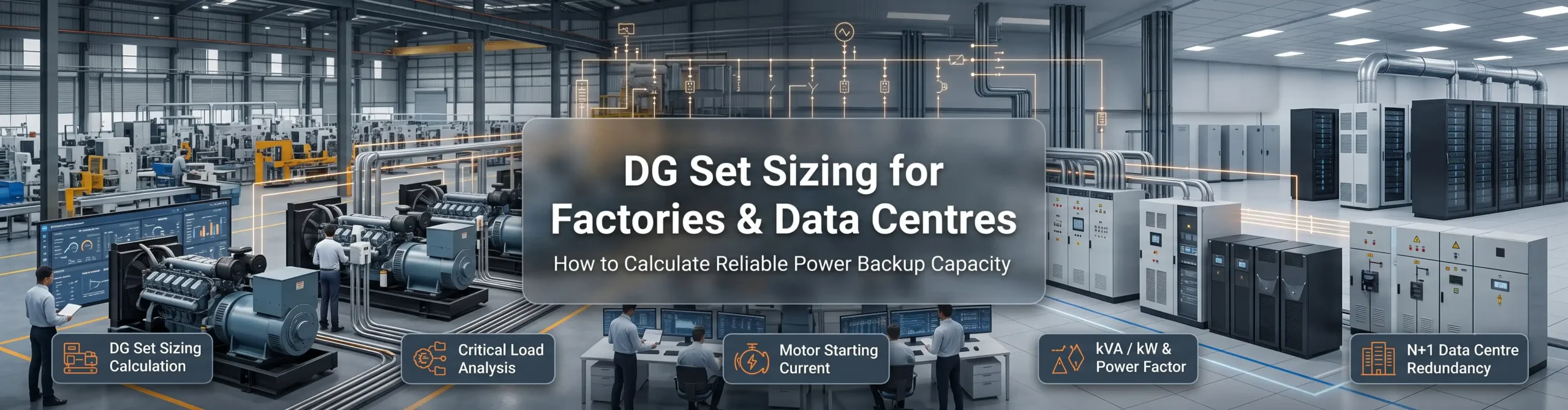
Reliable electrical power is essential in industries and data centers since failure in electrical supply will affect the manufacturing process and cause damage to machinery. The well-designed power back-up system ensures continued power supply during failure of power supply from utility.
For this very reason, DG Set Sizing goes beyond just sizing the generator depending on the connected load. Detailed analysis of demand, motor starting current, power factor, critical load, operating condition, growth, and redundancy needs should be carried out. HLK Infra, with its expertise in Electrical Engineering and EPC services, enables the business to have a reliable and efficient power back-up system.
Why Power Back-Up is Essential for Industrial Facilities and Data Centers
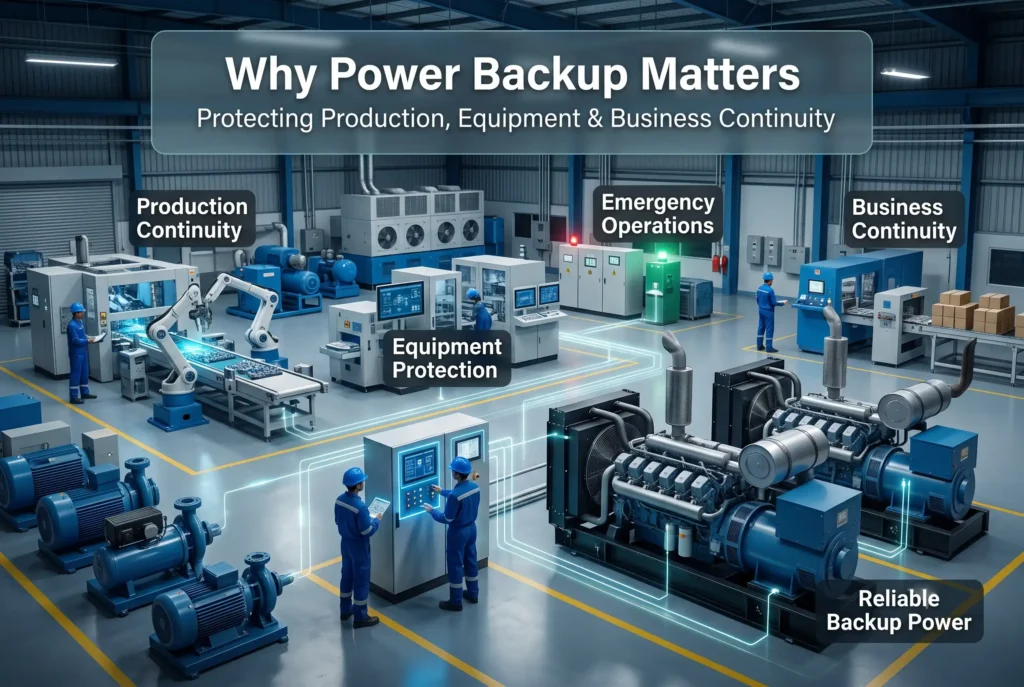
Unplanned electrical outages disrupt more than just electricity supply. With a reliable power backup, facilities and data centers can meet regulatory and safety requirements set by electrical and fire authorities. Here are some of the reasons why power back-up is essential:
- Prevents Production Downtime – For any manufacturing facility, loss of power can bring production machines, assembly lines, control systems, pumps, compressors, and conveying systems to a halt. Factory power backup systems can help sustain manufacturing processes and avoid losses during power outages.
- Protects Critical Equipment – Any power failure or fluctuation in the utility can impact motors, automation systems, servers, HVAC systems, and other sensitive equipment. Designing a proper backup power systems in India can minimize such risks.
- Ensure Business Continuity – Certain businesses such as data centres, financial facilities, healthcare environments, and process industries need constant electrical power for their operations. Data center power backup systems are used to keep their critical loads operational during the outage.
- Supports Emergency Operations – A backup generator can be used to provide emergency lighting, water pumps, security systems, communication systems, ventilation systems, and other emergency services.
- Compliance with Regulatory and Safety Standards – The electrical installations should be made in such a way that they conform to standards and regulations concerning electricity, environment, construction, fire, and safety in India.
What is a DG Set?
A Diesel Generator (DG) set is a combination of electro-mechanical machines which convert the mechanical energy generated in the diesel engine to electrical energy using an alternator.
The basic configuration of a DG set includes a diesel engine, alternator, fuel system, cooling system, exhaust system, starting batteries, control panel, protection devices, and other associated electrical items.
DG sets may be employed as a source of standby power where the generator runs only during the failure of utility supply or as a prime power where the generator acts as the main source of power generation for applications where the generator needs to operate for a longer duration.
What Is DG Set Sizing?
DG Set Sizing is an engineering discipline that involves estimating the generator capacity needed for reliable electrical load generation.
In the process of estimating DG set capacity, the normal operating load and transient loads such as motor starting need to be taken into account. The capacity of generators is usually given in kVA whereas power consumption of equipment in kW.
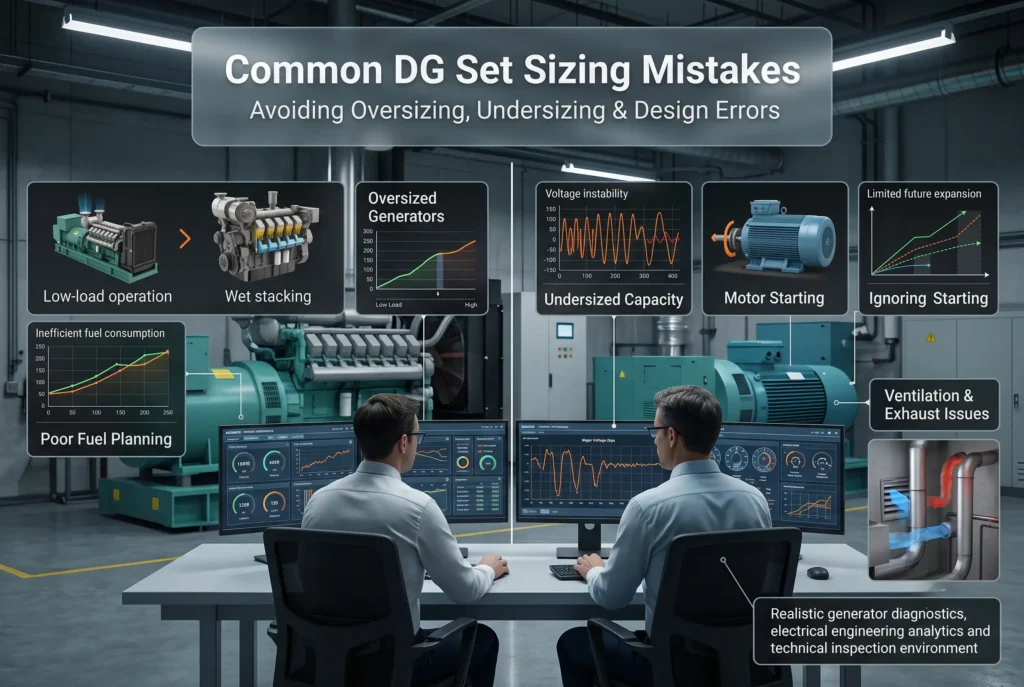
An under-sized generator can result in overload, high voltage and frequency fluctuations, and difficulty in starting large motors. On the other hand, an oversized generator operates continuously with low load, thereby leading to inefficient fuel utilization.
As a result, proper industrial DG set selection is important from the perspectives of performance, efficiency, and reliability.
Also Read This – High-Voltage Substation Construction in India
Factors to Consider Before Sizing a DG Set
- Connected Electrical Load – Total Connected Electrical Load on the complete load list must include motors, pumps, compressors, HVAC systems, lighting, processes, IT, fire pumps, and all other connected loads.
- Maximum Demand Load – A connected load doesn’t necessarily mean all loads operate simultaneously. An analysis of maximum demand load gives a better estimate of the total electrical demand of the plant.
- Motor Starting Current – Induction motors require much higher currents at startups. Hence, pumps, compressors, chillers, and all motor-driven equipment should be analyzed carefully while determining the size of the diesel generator set.
- Power Factor – The generator capacity is generally mentioned in kVA, whereas the load is often in kW. Power factor becomes an essential parameter for generator capacity estimation.
- Future Expansion Plan – While sizing the diesel generator set for any industrial establishment, future expansion plans should be considered, which may include the addition of machines, new production line, building, etc.
- Critical vs Non-Critical Load – Separation of critical from non-critical loads makes it possible for the generator to prioritize critical systems without increasing its capacity unnecessarily.
- Operating Hours – Operating hours of the generator affect fuel, cooling, emissions, and maintenance considerations among others.
Step-by-step DG Set Sizing Process
- Calculate Connected Load – Prepare a complete electrical load list with all equipment ratings, numbers, operation details, and power factors.
- Critical Loads Identification – Find out which systems have to be operated during a utility outage, and which loads will not have to be supplied until restoration.
- Maximum Demand Calculation – Analyse actual system operation in order to find out the demand.
- Motor Starting Loads Analysis – Take into account motor starting currents, methods, sequence and the ability of the generator to provide required voltage and frequency levels.
- Use Diversity and Demand Factors – These factors can help to avoid oversized calculations; however, they must be real and justified.
- Choose Suitable Generator Rating – Choose a suitable kVA/kW rating able to support maximum demand of your load with a proper engineering margin. Ambient temperature, altitude, ventilation, and installation conditions have to be taken into account.
- Compliance Check – The final design must comply with all the necessary electrical, environmental, fire, noise and safety regulations.
Power Design Back-up Requirements for Factories
Various types of factories will have different needs for a power backup system.
The manufacturing factory may require power backup for their machines, PLCs, compressors, pumps, conveyors, lighting, and automation systems. Starting motors is one of the primary concerns.
In the case of warehouses, power backup may be required for lighting, security, access control, fire protection systems, and refrigeration if needed.
For industrial process plants, proper sequencing of power generation may be a requirement since shutdowns will affect the process, machinery, and the product.
In the case of pharmaceutical industry, power backups may be required for HVAC systems, clean rooms, process equipment, monitoring systems, and refrigeration systems.
For food processing factories, power backup for refrigeration, process equipment, pumps, and HVAC systems, among others, may be a priority.
Power Design Back-up Requirements for Data Centers
The data center requires greater availability compared to several traditional facilities.
- Availability Requirement – The backup generator is required to support the critical facility during utility outages by providing the necessary availability of IT services.
- Integration of the UPS – The UPS system supplies instantaneous power while the generator gets started. The UPS, generator, switchgear, and distribution system have to be designed as one system.
- Redundant Generators – Depending on the architecture of availability, the data centers might operate in the N+1 or 2N modes. The N+1 ensures more capacity than required, while 2N provides the two different paths of capacity.
- Automatic Transfer Switch – The Automatic Transfer Switch (ATS) transfers the specified loads between utility and generator sources based on control and protection philosophy of the system.
- Continuous Power Supply – For reliable operation of the facilities, the integration between the generators, UPS systems, switchgears, cooling systems, monitoring systems, and critical distribution systems is needed.
- Tier Consideration – The redundancy of the generator and distribution system has to correspond to the data center’s availability and Tier needs.
Also Read This – What is EPC
Common Mistakes in DG Set Sizing
Connected load does not consider anything related to the demand, diversity factor, critical loads, or motor starting current.
- Ignoring Motor Starting Current
Higher starting currents could lead to a drop in voltage and generator instability if not accounted for.
- Over-Sized Generators
Generators that are too big may result in extended low-load operations as well as fuel wastage.
- Underestimating Future Expansion
Neglecting the projected expansion will cause generator replacement or electrical work in the future.
- Incorrect Fuel Storage Arrangement
The fuel tank should ensure that the required autonomy is met and also adhere to relevant safety and environmental standards.
- Ventilation and Exhaust Considerations
Generator systems need proper combustion air, heat rejection, exhaust handling, venting, and noise considerations.
- Industry Standards and Compliance
DG Systems in India have to adhere to various electrical, environmental, building, fire, and safety standards. Central Electricity Authority (CEA) regulations have requirements with respect to electricity.
- Industry Standards and Regulations
The DG installations in India should satisfy all the relevant electrical, environmental, building, fire, and safety requirements. The Central Electricity Authority (CEA) has regulations concerning electrical safety and supply.
The emission norms of CPCB have to be considered for diesel generator sets as well. Requirements may depend on the type of generators, the regulations, and the installation requirements.
Why Choose HLK Infra for Power Backup & DG Set Design?
HLK Infra provides integrated industrial electrical engineering solutions for industries, factories, industrial plants, commercial buildings, and data centers. Right from electrical load calculation, DG Set sizing calculation, design, EPC execution, installation, and commissioning, we ensure complete support for the entire project cycle.
Some of the features offered include industrial electrical design, HT/LT system design, generator sizing, electrical load calculation, BIM coordination, EPC execution, fire and HVAC coordination, PMC, and Annual Maintenance Contract (AMC).
Through engineering and coordinated project execution, HLK Infra enables its clients to build a reliable power back-up system according to their requirements and future plans.
Conclusion
Proper DG Set Sizing is extremely essential to provide effective power back-up for plants and data centers. Generator sizing is not simply dependent on load connected, but many other factors have to be considered while sizing the generator.
Taking into consideration our experience in designing electrical systems along with the expertise in BIM, EPC services, HVAC and fire safety, HLK Infra can assist organizations in developing power back-up infrastructure.
Questions People Frequently Ask
DG capacity is calculated based on demand load, critical loads, motor start requirements, power factor, diversity, conditions and future expansion.
Load profile, motor start requirements, power factor, number of hours of operation, environmental conditions, redundancy and future requirements influence the choice of capacity.
kW represents real power and kVA is apparent power in generators; power factor affects their relation to each other.
Redundant power supply system’s ensure reliability in case of failures, servicing and unexpected conditions in the system.
Yes, if the capacity and distribution system of the DG set are correctly chosen and are properly designed for the factory’s operating and starting loads.
Tests and maintenance should be conducted according to manufacturers’ specifications, applicable laws and regulations, and preventive maintenance programs.