

Table of Contents
- What Is Rainwater Harvesting for Industrial Campuses?
- Why Do Industrial Campuses Need Rainwater Harvesting?
- How Does an Industrial Rainwater Harvesting System Work?
- Key Components of a Rainwater Harvesting System
- Types of Rainwater Harvesting Systems for Industrial Sites
- Benefits of Rainwater Harvesting for Industries
- Rainwater Harvesting Design Considerations for Industrial Campuses
- Rainwater Storage vs. Groundwater Recharge
- Combining Rainwater Harvesting with Industrial Water Management
- Maintenance and Monitoring of Rainwater Harvesting Systems
- Regulatory and Compliance Considerations in India
- How HLK Infra Supports Industrial Water Management
- Conclusion
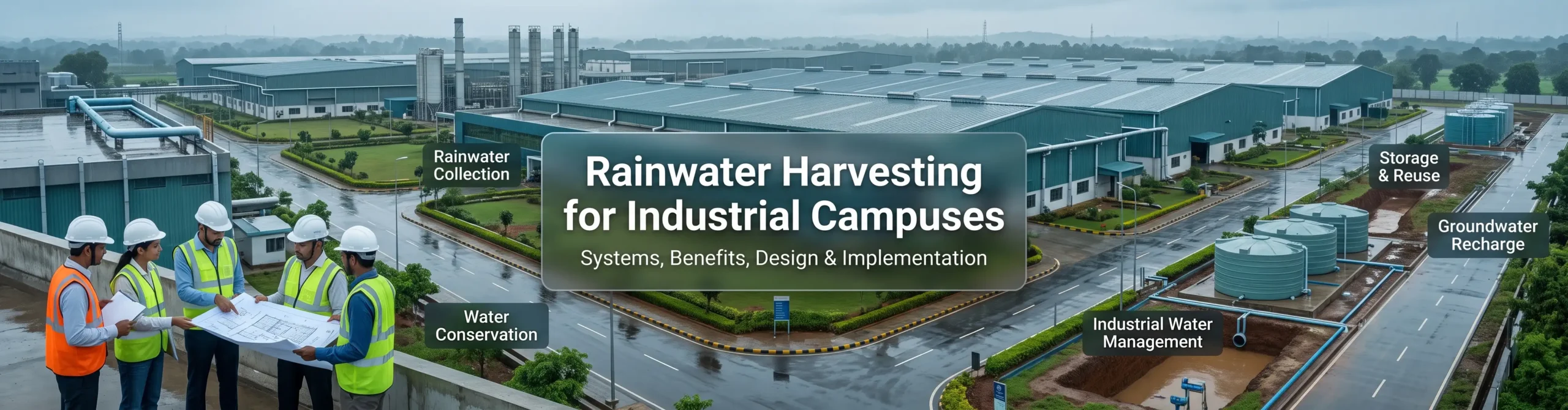
Industrial complexes will also tend to have a lot of roofing, pavement, roads, parking areas, warehouses, and other utilities that are bound to produce lots of storm water runoff whenever there is rain. Rather than having this water runoff, industry could collect, treat, store, recycle, or recharge the rainwater using a proper rainwater harvesting system.
For HLK Infra, rainwater harvesting is part of its integrated water management strategy, especially when dealing with industrial complexes that require attention to water demand, site drainage and environmental performance together. Properly designed systems would help in water conservation at industrial complexes, reduce reliance on fresh water sources and proper water recycling in industries.
What Is Rainwater Harvesting for Industrial Campuses?
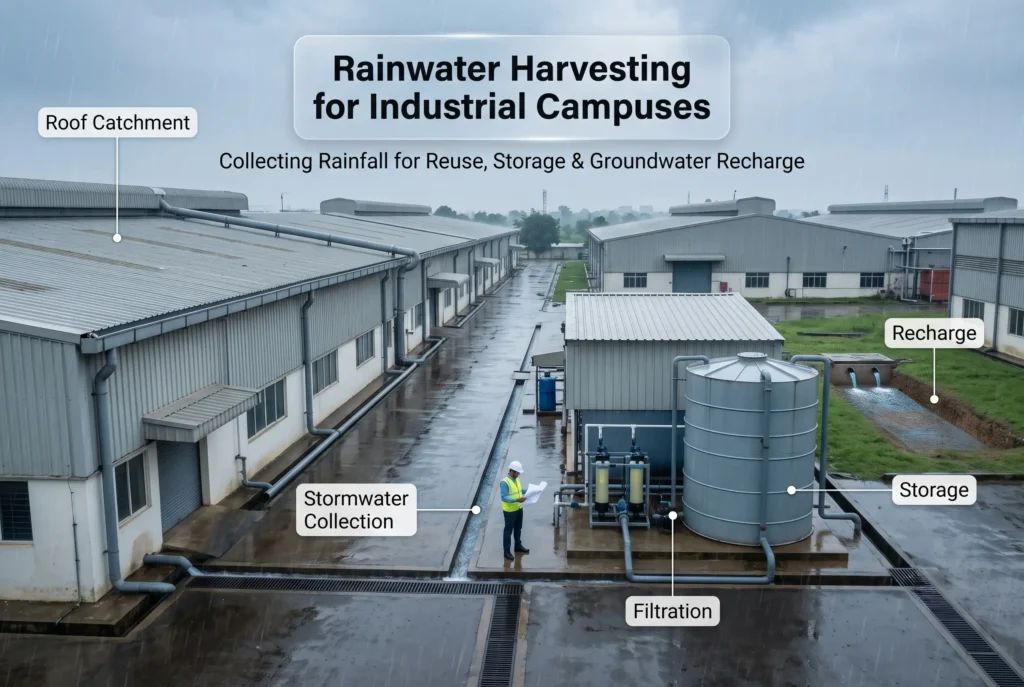
Rainwater harvesting for industrial campuses comprises the collection of rainfall from appropriate catchment sources like rooftops and then routing of collected rainwater through filtering and treatment processes to be stored, reused, or recharged into the ground.
According to Central Ground Water Board (CGWB), rainwater harvesting is defined as the collection of rainwater on the surface and underground in subsurface aquifers before its loss as runoff. The CGWB also acknowledges artificial recharge as a method of increasing the groundwater quantity.
Thus, in an industrial site, such a system can be applied for two purposes simultaneously: the provision of water for various non-potable applications and the recharging of groundwater resources in favorable hydrogeological conditions.
Also Read – Smart Pipelines Are Reducing Water Loss in Indian Cities
Why Do Industrial Campuses Need Rainwater Harvesting?
Industrial campuses can require large amounts of water due to processes like manufacturing, cooling, cleaning, sanitation and irrigation among others. On the other hand, large industrial buildings offer large surfaces to harvest rainwater.
A number of studies carried out for industrial buildings suggest that this particular combination of a high-water consumption rate and large roof surface area is suitable for installing a rainwater harvesting system. According to a 2024 industrial building case study, the design, capacity and expected savings from such a system greatly depend on the characteristics of site-specific water consumption and rainfall.
The effective implementation of the rainwater harvesting systems may assist the industrial clients of HLK Infra in:
- Decreasing dependence on external water sources
- Collecting the stormwater
- Meeting the needs of non-potable water
- Putting less pressure on water resources of the area
- Improving water management in the campus
- Assisting in the replenishment of ground water when necessary
- Developing water conservation strategies
How Does an Industrial Rainwater Harvesting System Work?
The typical procedure for rainwater harvesting in the industrial sector consists of stages like collection, conveying, filtering, storing and distributing.
Rainwater is initially collected from selected roof or paved catchment areas. It is conveyed to collecting points through gutters, downpipes and drainage channels. The first part of the runoff is diverted when necessary to wash away dust particles, debris, and other pollutants.
The collected water will next be filtered or treated before being channeled to storage tanks or recharge facilities. Water that is stored can later be distributed for specific non-drinking purposes, like watering the lawn, cleaning, or toilet flushing, among others, based on the water requirements.
The exact design should depend on the amount of rainfall, catchment area, water needs, water quality, soil and its intended use.
Also Read – Smart Water Management in India
Key Components of a Rainwater Harvesting System
Key Components | Details |
Catchment Areas | Roofs, terraces, and any other appropriate areas catch the rain. |
Gutters and Drainage | The gutters and pipes carry the runoff to the storage facilities. |
Filters | Filtering helps in removing impurities from runoff before storing or recharging. |
Storage Tanks | The tanks store water temporarily or seasonally for further use. |
Recharge Pits | This is where appropriate filtered runoff can seep into the soil. |
Recharge Wells | Recharge wells can be used if the hydrogeology and the site allow. |
Distribution Systems | The pumping and pipelines will help in distributing the water. |
Types of Rainwater Harvesting Systems for Industrial Sites
The industrial campuses can adopt various layouts depending on their goals and available conditions.
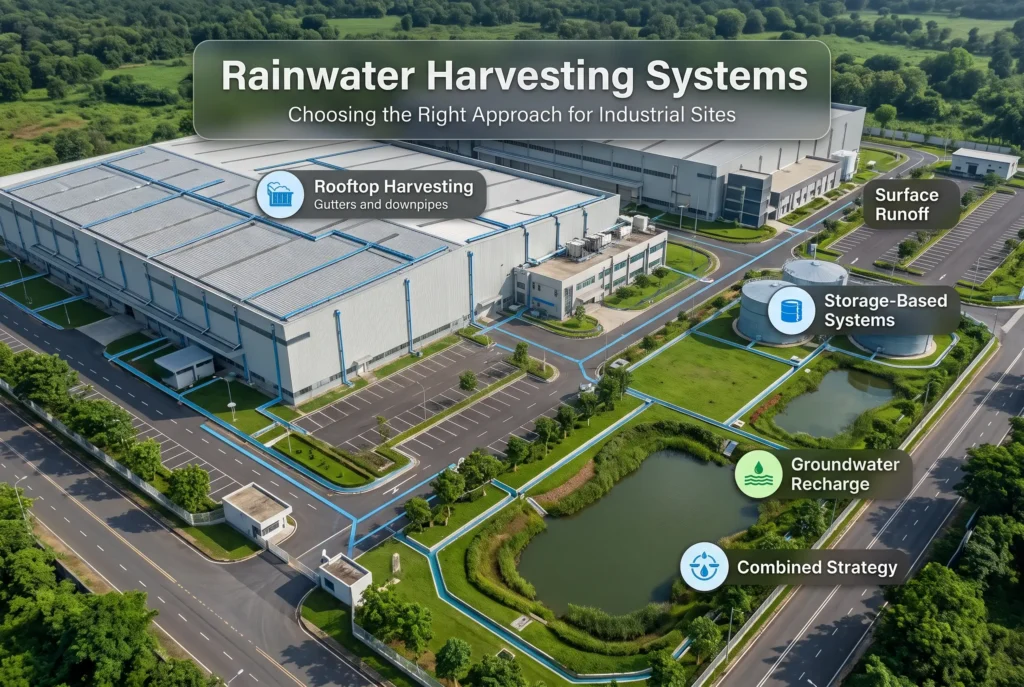
- Rooftop harvesting systems – Harvest rainwater from factory buildings, warehouses, and administrative buildings.
- Surface runoff harvesting systems – Harvest the surface runoff from the paved surfaces and other appropriate surfaces of the site following evaluation and processing.
- Storage-based systems – Store the harvested water for future uses that are not for drinking purposes.
- Groundwater recharge systems – Direct the appropriate rainwater to recharge pits, shafts, and wells after proper filtration and evaluation of the site.
For most industrial developments, a combined strategy would be more flexible since the harvested water would partly go for reuse while the rest goes for recharge.
Benefits of Rainwater Harvesting for Industries
First, the efficiency of resource utilization is enhanced through rainwater harvesting. This is achieved by replacing the harvested rainwater with non-potable uses of water, which reduces the industry’s need for freshwater.
Additionally, rainwater harvesting may be useful in stormwater management because rainwater harvesting helps capture the flow of water during rainy seasons. Research done in the industrial sector shows that rainwater harvesting on-site can help reduce the use of freshwater.
From HLK Infra perspective, some of the benefits from adopting rainwater harvesting include:
- Water conservation
- Freshwater savings
- Effective stormwater management
- Possibility of groundwater recharge
- Resistance to water shortages
- Sustainability
- Water reuse in industries
Rainwater Harvesting Design Considerations for Industrial Campuses
According to HLK Infra, factors such as annual and seasonal rain pattern, catchment area, runoff nature, water demand, storage capability, soil conditions, ground water conditions and water quality considerations need to be considered when designing.
The connection between the availability of rainfall and industrial water demand is especially important. If storage is too small, there will be a lot of overflowing; if the storage is too big, there would be an increase in costs without providing any proportionate advantages.
Water quality of collected water needs to be determined depending on the purpose of its utilization. If it is meant to be reused, the level of water treatment should be adequate; if the goal is to recharge, contamination risks need to be assessed.
Rainwater Storage vs. Groundwater Recharge
Aspect | Rainwater Storage | Groundwater Recharge |
Purpose | Stores collected rainwater for future use. | Transfers suitable rainwater into the subsurface to replenish groundwater sources. |
Best Suited For | Industrial facilities with regular demand for non-potable water. | Sites where groundwater replenishment is appropriate based on local conditions. |
Key Considerations | Storage capacity, water demand, water quality, and intended use. | Soil conditions, aquifer characteristics, water quality, and site suitability. |
Water Use | Stored water can be reused for suitable non-potable applications. | Water is directed into the ground rather than stored for direct reuse. |
Site Assessment | Focuses mainly on water demand and required storage capacity. | Requires assessment of soil, aquifer conditions, and recharge suitability. |
Technical Guidance | — | CGWB provides technical assistance related to site investigation, selection, design, and monitoring of artificial recharge systems. |
Combining Rainwater Harvesting with Industrial Water Management
The process of rainwater harvesting cannot stand alone as a drain system. Rainwater harvesting could become part of the bigger picture when it comes to the industrial water management scheme.
HLK Infra is capable of integrating the rainwater harvesting technology with demand assessment, water conservation technologies, wastewater treatment, process water optimization, storage and proper utilization of rainwater.
In case treated wastewater is available, it is possible for industries to consider reusing water in their industries depending on the quality requirements.
Maintenance and Monitoring of Rainwater Harvesting Systems
Maintenance is critical for the success of rainwater harvesting. Catchment areas, gutters, filters, tanks, pumps, pipelines and recharge structures need periodic checking by industrial users. The sediment and other matter need to be cleared when required, while filters and water treatment systems need to be maintained based on their requirements.
According to HLK Infra, maintenance of records related to rainfall, volume collected, storage, utilization and performance of the rainwater harvesting system is advised when possible.
Regulatory and Compliance Considerations in India
There may be different requirements for rainwater harvesting and recharging of ground water based on location, local regulations, building requirements, and other factors. The framework of regulations of India related to ground water also includes regulations regarding abstraction of ground water in certain locations.
Both the CGWA and CGWB provide useful guidance regarding regulatory issues related to the development of ground water, artificial recharge, and rainwater harvesting. It is indicated that the states and UTs have made provisions for rainwater harvesting to different extents, while abstraction of ground water may be regulated in certain areas.
Industrial projects should check the relevant requirements in each state and local area.
How HLK Infra Supports Industrial Water Management
HLK Infra considers industrial rainwater harvesting as a means of integrated infrastructure and water management. Instead of just installing tanks and recharging systems, the aim here is to create a system which is in sync with the rainfall, catchment, water requirements, drainage and the environment at the location.
HLK Infra may assist in:
- Industrial site water assessment
- Planning for the rainwater harvesting system
- Planning for catchment and drainage
- Planning of storage and recharge strategies
- Water conservation planning
- Integration with industrial infrastructure
- Planning for water reuse
- Coordination and implementation support
A properly planned rainwater harvesting system for industries can ensure that stormwater, instead of being an annual problem, can become a source of usable water. Through proper collection, filtration, storage, reuse and recharging methods, rainwater harvesting for industries can prove to be very effective in water management.
Integrating rainwater harvesting in industrial infrastructure is one such example of responsible water management through HLK Infra.
Conclusion
Rainwater harvesting is one of the most useful approaches to improving water management within industrial campuses. The proper rainwater harvesting system designed for industries can allow for effective utilization of rainfall through proper storage, filtration, reuse and groundwater recharge. The system also enables water conservation in industries and can help reduce the dependency on freshwater sources along with providing opportunities for water reuse in industries.
For HLK Infra, incorporation of rainwater harvesting in the industrial infrastructure involves designing solutions considering the conditions of site, rainfall pattern, water requirement, catchment area and other relevant factors. Proper design, installation and maintenance of rainwater harvesting systems allow industries to manage their water resources effectively.
Questions People Frequently Ask
The process of collecting, purifying and storing rainwater for reuse is regarded as rainwater harvesting for industrial campuses. It decreases reliance on freshwater sources.
It conserves freshwater, manages stormwater runoff, lowers water costs, and supports efficient industrial water management.
Rainwater that is harvested can be used for cleaning, flushing, landscaping and cooling, and helps in conserving freshwater in industrial settings.
Consider rainfall, catchment area, storage size, water requirements, treatment, available space and compliance with local regulations.
Rainwater after being treated can be reused for landscaping, cleaning, flushing, cooling purposes and other suitable non-potable industrial applications.