

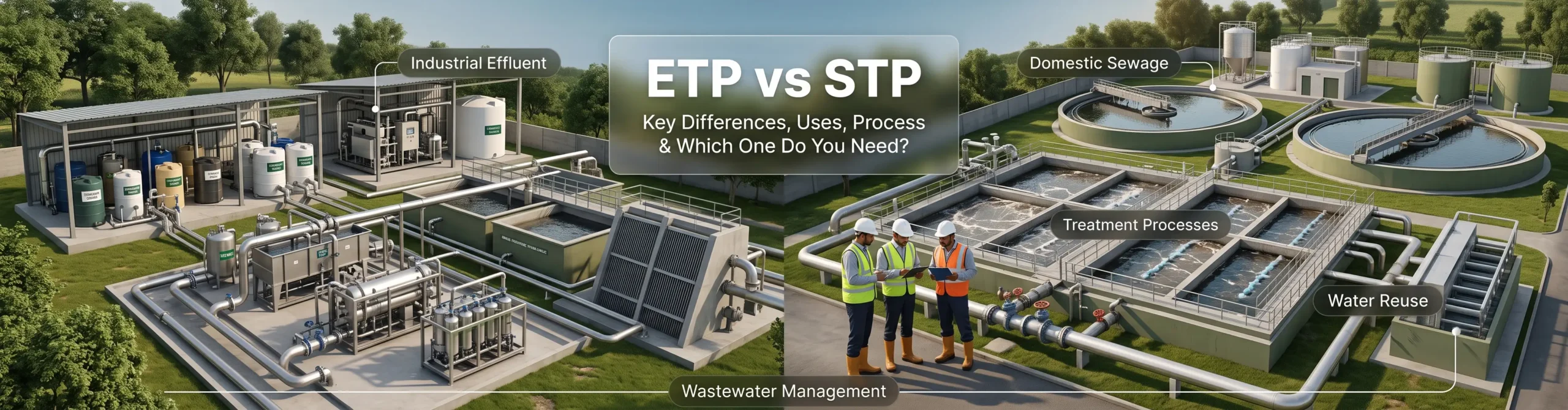
In case of wastewater management, selection of wastewater treatment systems goes beyond installing a wastewater treatment plant. The type of wastewater, type of pollutants, origin, need for treatment and intended use of treated water all go into determining the appropriate choice of wastewater management. In this regard, knowledge of the difference between Effluent Treatment Plant (ETP) vs Sewage Treatment Plan (STP) becomes very crucial.
Here at HLK Infra, We understand that the nature of industrial and domestic wastewater is completely different. ETP is mainly meant for industrial effluent, whereas STP treats domestic sewage. Let us know the difference between ETP and STP
What is an Effluent Treatment Plan?
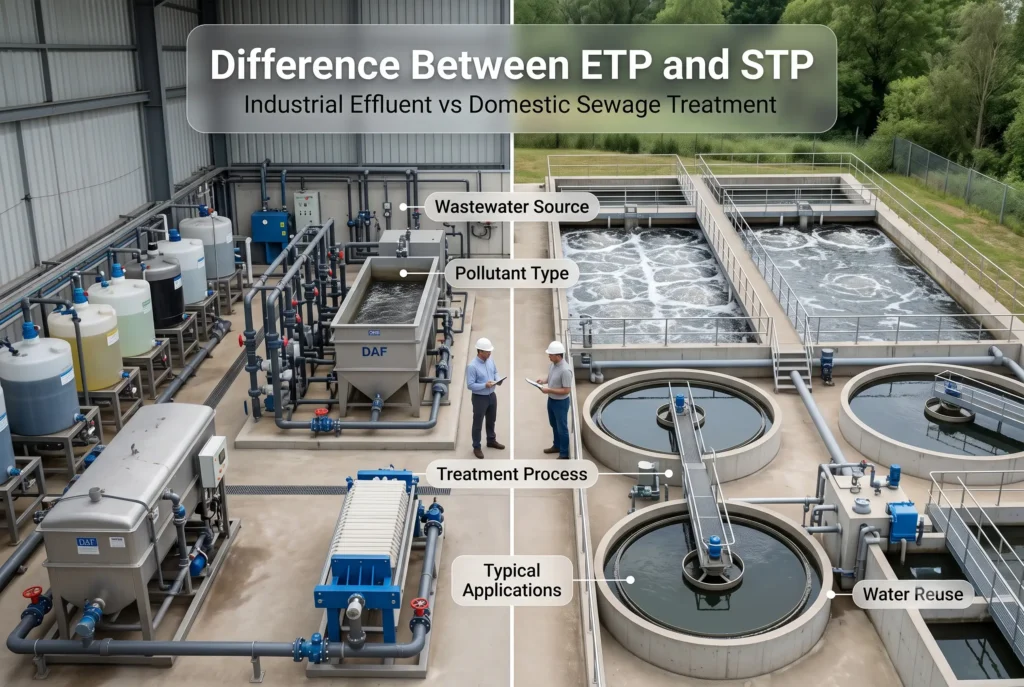
The Effluent Treatment Plant (ETP) is designed to treat the wastewater from industries before it is released into the environment and reuse on-site. An ETP plant has a more rigorous purification system as compared to a sewage treatment plant due to chemicals, oils, heavy metals, and other pollutants present in the effluents of industrial processes.
Also Read This – Water Management in India
How does ETP work?
The working principle of a typical ETP treatment plant includes the following processes:
- Physical treatment through screening and sedimentation to filter out solids and suspended impurities.
- Chemical treatment by means of coagulation and neutralization of dissolved chemicals and pH balancing.
- Biological treatment utilizing the action of microorganisms for breakdown of organic matter.
- Advanced/tertiary treatment by filtration and disinfection of the treated water
Where is ETP installed?
Industrial effluent treatment by ETP is essential in the following industries:
- Textile industry
- Pharmaceutical industry
- Chemical industry
- Food processing industry
- Manufacturing industries
An ETP plant is designed for treating the effluents containing chemicals, oils, heavy metals, and other pollutants of a particular industry.
What is a Sewage Treatment Plan?
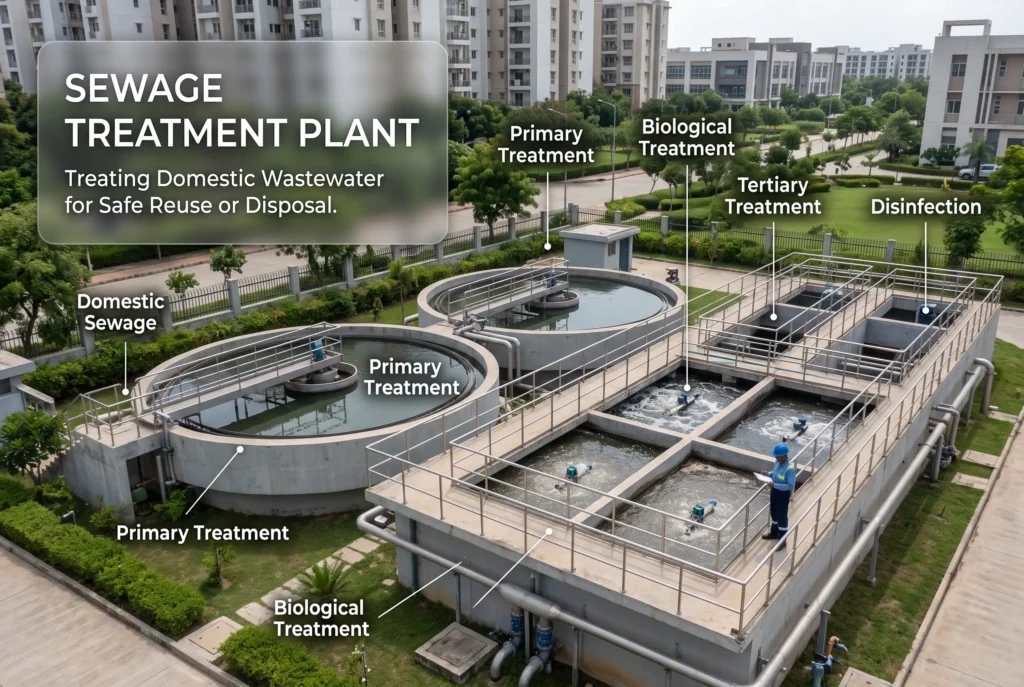
A Sewage Treatment Plant (STP) refers to the treatment of domestic sewage that is, the sewage which is created due to everyday activities of humans and not due to any industrial process. The purpose of an STP plant is to filter out the organic material, suspended solids, and pathogens in order to make the sewage safe to be used or disposed of.
How does STP work?
Sewage treatment normally involves:
- Preliminary treatment, which removes debris and grit
- Primary treatment where solid suspended particles settle
- Biological secondary treatment where micro-organisms breakdown the organic material
- Tertiary treatment where more filtration takes place to make the water clear
- Disinfection where pathogens are killed
Where is STP used?
Domestic sewage treatment using an STP is common in:
- Residences, societies
- Apartments
- Hotels
- Office spaces
- Educational institutions
- Commercial buildings
STP mainly treats domestic sewage consisting of organic material, suspended solids, and pathogens rather than industrial contaminants.
ETP vs STP: Key Differences
Factors | Effluent Treatment Plan (ETP) | Sewage Treatment Plan (STP) |
Wastewater Source | Industrial | Domestic or sewage wastewater |
Main Pollutants | Chemicals, oils, heavy metals, industrial contaminants | Organic matter, solids, pathogens |
Treatment | Physical, chemical and biological | Mainly physical and biological, with additional stages as required |
Common Applications | Factories and industries | Homes, apartments, hotels and offices |
Complexity | Generally higher and industry-specific | Generally moderate and sewage-focused |
Water Reuse | Industrial processes/reuse depending on treatment | Gardening, flushing and other non-potable uses |
ETP or STP: Which One is the Right Treatment Plan for Your Facility?
If your industrial plant is producing some type of wastewater, then you will have to consider getting an ETP. On the other hand, if you are dealing with residential complexes, hotels, offices, or institutions, you will require an STP system which is used for residential and commercial buildings. Whether to go with an ETP or STP system basically depends upon the source of your wastewater.
Benefits of ETP or STP Systems
Other than ensuring compliance with regulations, the systems can contribute to the actual improvement of your waste water management by providing the following advantages:
- Less environmental pollution and contamination
- Water recycling for non-potable purposes like irrigation and flushing purposes
- Reduction in the use of freshwater
- Compliance with pollution control standards
- Sustainability of facilities and developments
At HLK Infra, we offer designs of both the ETP and STP systems considering the above-mentioned advantages.
Cost and Maintenance of ETP vs STP
The cost and maintenance of Effluent Treatment Plant (ETP) and Sewage Treatment Plant (STP) can differ substantially based on several aspects like treatment capacity, technology used, specification of equipment, composition of wastewater, and treatment norms of a specific project.
Overall, the installation of an ETP will cost more money compared to installation of an STP because industrial effluents require multi-staged treatment involving physical, chemical, and biological methods due to a greater variety of contaminants. As far as maintenance goes, STP requires maintenance associated with the monitoring of biological treatment process, servicing equipment, and removing sludge. However, an ETP might require monitoring of chemical dosing and treatment process parameters, and maintenance of mechanical and electric equipment.
HLK Infra considers the cost of installation and maintenance of the wastewater treatment system when recommending a solution for a specific project.
Conclusion
Understanding the difference between ETP and STP is the key to successful wastewater treatment. Though both facilities are meant for the treatment of wastewater, their design and the process itself depend upon different characteristics of the wastewater. ETP is designed to treat Industrial Wastewater that includes hazardous chemicals and other pollutants. On the other hand, STP is designed to treat wastewater that comes from residential, commercial and sewage wastewater.
HLK Infra can approach the requirements based on wastewater characteristics, capacity, treatment objectives, site conditions, and reuse requirements.
An adequate wastewater treatment plant cannot be determined by the number of treatment steps alone. It is infact the plant that is appropriately designed for the treatment of wastewater.
Questions People Frequently Ask
Neither is universally better as both the plants are built with different objectives. ETP is meant for treating industrial wastewater, while STP is designed to treat domestic sewage.
Depending upon the nature and characteristics of the wastewater produced, industries like textile industry, pharmaceutical industry, chemical industry, food processing industry, dairy industry, etc., require an ETP.
Yes, if a plant produces industrial wastewater and domestic sewage, both plants will have to be installed separately as each plant is designed to treat the respective waste streams.
Generally, STP cannot treat industrial wastewater as an ordinary STP is designed to treat domestic sewage only.
The frequency depends on applicable regulations, installation type, risk level, operating conditions and maintenance requirements; organizations should follow relevant statutory and technical guidance.