

The construction process in India presents itself as a complicated pathway that requires your experience from previous construction projects in India to understand its challenges. The construction process, which should bring excitement, actually turns into a difficult experience because of various issues, including multiple vendors who change their schedules, and the project exceeds its budget while teams fail to communicate. Design to build services provide exactly this solution, which has established itself as the leading construction method for commercial, industrial, and institutional facilities.
HLK Infra and other companies that work in this industry provide comprehensive solutions that combine design and engineering, procurement, and construction services into one package.
Table of Contents
Introduction
The design-to-build construction method executes its operations by assigning dedicated team resources to complete all project tasks, which encompass both planning and design work and the execution of projects until their final delivery. The design-to-build construction method streamlines project operations while decreasing project delays and improving project delivery through better coordination between all project phases.
The integrated solution requirement of Indian developers has increased because they search for an infrastructure partner who can deliver dependable services for their intricate project needs. The approach functions across various sectors, which include commercial spaces, industrial facilities, institutional buildings, and infrastructure projects, because these sectors need to maintain operational efficiency while controlling expenses and preserving product quality.
What Are Design to Build Services?
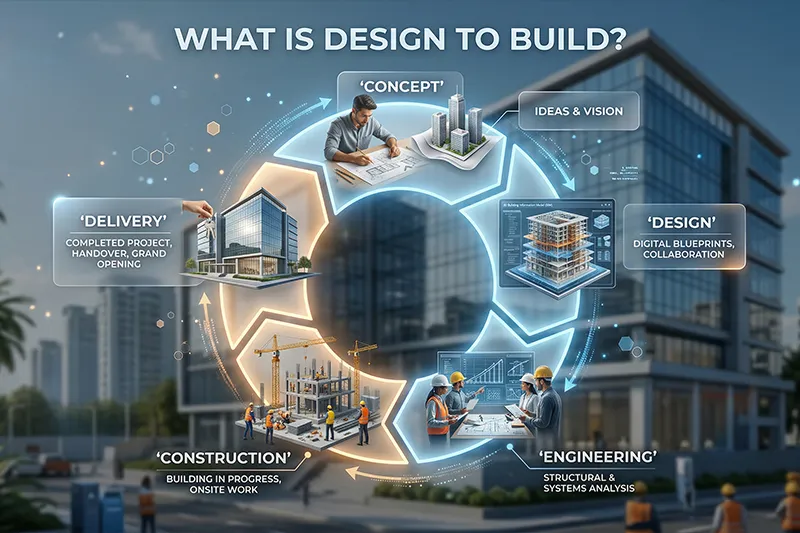
Design-to-build services allow clients to manage their entire project through a single contract that combines design work with building construction. The expert team handles all project stages from initial concept development to final project delivery, which results in improved project communication and better project results.
The integrated model delivers projects more quickly because design work and construction work proceed simultaneously, which decreases project interruptions and increases project completion speed. The system enables cost savings through two main methods, which include better resource management and protection against budget excesses and decreased design alterations.
The approach uses turnkey contracting as its main method to deliver projects, resulting in completely finished projects that customers can use immediately. The turnkey design to build services model that commercial builders use provides complete project solutions, which benefit commercial projects that need fast, accurate, and dependable results.
Why Design and Build is Gaining Popularity in India
The increasing demand for design-to-build services in India results from various factors that are transforming the countrywide construction and infrastructure development sector.
The main element that controls the situation originates from the quick growth of urban areas. The construction teams need to complete their tasks through rapid building methods, which can manage multiple active projects without causing work delays, because urban areas are growing and new facilities are being built.
The government has implemented smart cities and large-scale development projects, which contribute to the ongoing urbanization trend. The projects require precise project management because they involve multiple tasks that need unified infrastructure solutions to build roads, public facilities, and utility systems.
The current situation demands that organizations achieve operational efficiency while maintaining responsibility. The infrastructure company in India provides clients with advantages because they control one organization, which enhances communication efficiency and decreases project risks in comparison to working with different contractors.
The shift is occurring because of several reasons, which already exist in addition to these reasons.
- The establishment of unified teams creates a faster decision-making process because they handle both design and execution activities.
- Quality control improvements occur because project standards remain consistent throughout all project phases.
- Integrated planning combined with resource management delivers better cost estimation results.
- The implementation of modern technologies, such as BIM, enables accurate design and execution processes.
- Sustainability focus, with integrated teams enabling greener and more energy-efficient construction practices
The combined advantages of design-to-build construction methods produce a practical solution that meets the upcoming construction requirements of India.
Key Components of Design2Build Services
- Architectural Design & Planning – Architectural design and project planning are the foundation of successful project execution. This phase involves concept development through space planning and detailed layout design while securing necessary authority approvals. The focus is on creating visually appealing designs that meet functional requirements and comply with regulations. Leading design-to-construction firms in India help clients transform their vision into reality through efficient execution. Green building architects also emphasize sustainability by incorporating energy efficiency, natural lighting, and eco-friendly materials.
- Engineering & EPC Solutions – After the design phase, projects move into detailed engineering and execution planning. This includes structural engineering, MEP (mechanical, electrical, and plumbing) systems, and civil engineering services to ensure safe and efficient construction. EPC (Engineering, Procurement, and Construction) models streamline procurement and construction planning processes. These services are widely used for high-rise, institutional, and industrial projects, offering complete project management from design to final delivery through integrated IEPC solutions.
- Construction & Project Management – This phase focuses on on-site execution and overall project management. It involves managing labor, materials, equipment, and construction schedules to ensure smooth progress. Professional teams monitor all project activities to ensure timely completion, cost control, and adherence to quality standards. Experienced IEPC contractors play a key role in executing large-scale industrial and warehouse projects that require precision, safety, and scalability. Together, these elements create an efficient, cost-effective, and high-quality Design2Build system.
Sector-Wise Design to Build Applications
- Commercial and Retail Projects – Existing in today’s market, design-to-build services have become essential for development. This method ensures faster project completion while delivering exceptional results for shopping centers, office buildings, and mixed-use projects. These services improve building layouts, customer movement, and overall business efficiency. The growing demand for high-end office environments also requires integration of smart technologies and sustainable practices, allowing developers to execute large-scale commercial projects with speed, accuracy, and cost efficiency.
- Industrial & Manufacturing Projects – India’s industrial sector requires scalable infrastructure solutions to support its rapid growth. Design2Build services provide integrated design and execution for factories, warehouses, and logistics centers. These solutions help create operational facilities that meet compliance standards and are future-ready. Industrial and Warehouse Construction Services (IEPC) offer complete engineering, procurement, and construction support for large-scale industrial developments.
- Institutional Projects – Institutional infrastructure must focus on efficiency, safety, and regulatory compliance. Design-to-build services offer complete solutions for educational and healthcare facilities. From schools and colleges to engineering institutions, these services create modern learning environments. In healthcare, they support the development of advanced hospitals and medical colleges that meet strict operational and medical requirements.
- Infrastructure & Urban Development – Large infrastructure projects require detailed planning and precise execution. Design-to-build models are widely used for roads, utilities, and smart city developments due to their ability to ensure proper coordination and timeline management. Integrated EPC solutions improve efficiency, reduce risks, and enhance cost control in complex public infrastructure projects.
- Specialized Projects: Data Centers – With the rapid expansion of digital infrastructure, data centers have become a critical area for design-to-build services. These projects require specialized planning to ensure performance, reliability, and security. Datacenter Design & Build services focus on advanced cooling systems, uninterrupted power supply, and strong security frameworks, ensuring energy efficiency and maximum uptime.
Benefits of Design to Build Services
- Single-point accountability – Design-to-build services provide a single partner responsible for the entire project, allowing clients to manage progress easily through one point of contact.
- Faster turnaround time – Project delivery becomes faster as design and construction activities run simultaneously, reducing overall timelines.
- Cost savings – Better planning, fewer design changes, and efficient resource management help maintain strong budget control.
- Better coordination – Direct communication between architectural, engineering, and construction teams minimizes misunderstandings and delays.
- Reduced risk – Integrated execution lowers operational errors, prevents conflicts, and ensures smoother handling of unexpected challenges.
Design-Build vs Traditional Construction
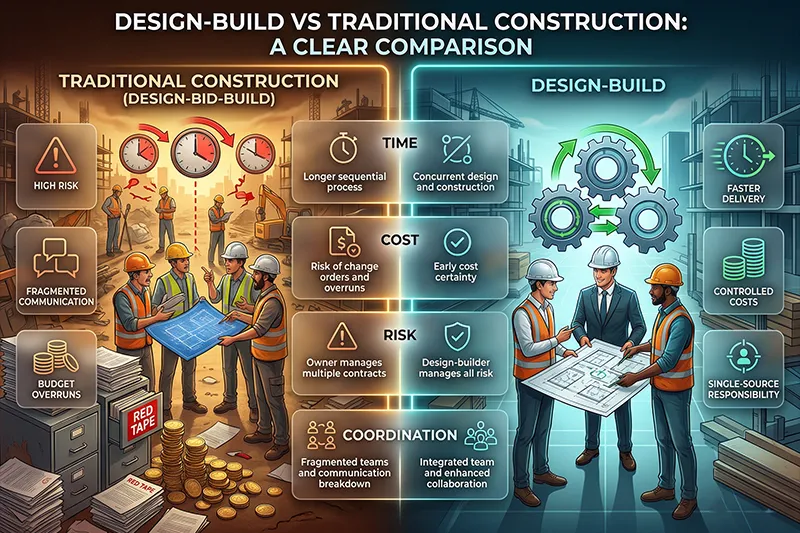
- Single-point accountability – Design-to-build services provide a single partner responsible for the entire project, allowing clients to manage progress easily through one point of contact.
- Faster turnaround time – Project delivery becomes faster as design and construction activities run simultaneously, reducing overall timelines.
- Cost savings – Better planning, fewer design changes, and efficient resource management help maintain strong budget control.
- Better coordination – Direct communication between architectural, engineering, and construction teams minimizes misunderstandings and delays.
- Reduced risk – Integrated execution lowers operational errors, prevents conflicts, and ensures smoother handling of unexpected challenges.
Conclusion
Design-to-build services provide construction projects with an advanced method that combines design work and construction execution at a single location. The integrated method delivers three benefits, which include shorter project completion times, improved cost management, and decreased risk levels.
Design-to-build construction methods provide businesses with a faster and more dependable building process because of India’s rapid economic development.
Contact HLK Infra experts for project planning consultations, which will provide you with complete project solutions.
Questions People Frequently Ask
A method where one company handles both design and construction, which results in faster project delivery and better project coordination between the two disciplines, is typically known as the design to build construction
Design-build combines design + construction, which EPC defines as engineering procurement and construction that applies to big projects.
IEPC services provide complete project delivery through their engineering, procurement, and construction services, which support industrial and infrastructure development projects.
The system allows institutional projects to meet all compliance requirements while achieving efficient design and completing work on schedule.
The project costs depend on its size and type, but most projects become cheaper because they experience fewer delays through better project scheduling.