


A construction contract defines the legal, financial, and operational framework surrounding construction in India. All elements of an EPC contract in India, from scope definitions through to guaranteed performance, affect the schedule, quality, and risk related to the project. By reviewing the EPC agreement, project owners can reduce the likelihood of disputes, limit costs, and ensure that the project is completed successfully.
For project owners, investors and developers, signing an EPC Agreement before a proper analysis can lead to excessive cost overruns, delays, disputes and/or inferior quality construction at the time of project completion. This is why many established infrastructure firms, such as HLK Infra, suggest putting forth the effort to conduct a thorough review of the contract prior to the commencement of a project.
What is an EPC Contract
An EPC contract is a project delivery model that provides for the contractor to be liable for engineering and design, procurement of materials and equipment, construction, and execution of the project, and the testing and commissioning process.
In its simplest form, an EPC contract is an arrangement under which a project is delivered by a contractor within agreed cost and in a reasonable time frame under an Engineering & Construction EPC arrangement. This model provides a means of reducing coordination challenges because a project owner needs to deal with only one primary contractor rather than multiple vendors.
In India, the EPC contracts are utilized widely in:
- Real estate developments
- Infrastructure projects
- Industrial construction
- Power and energy projects
- Water treatment facilities
- Highways and metro projects
Companies like HLK Infra adopt structured EPC practices to deliver projects on time, ensure quality compliance, and mitigate associated risks.
Key Clauses Every Project Owner Must Understand
Here are some of the Important Clauses Every Owner Should Know
- Scope of Work Clause – A Project Owner’s agreement shall contain an EPC India Scope of Work (SOW) Clause, which is critical to the Owner and shall be incorporated in all Owner / Contractor Agreements.
The Scope of Work Clause may contain:
- Project Deliverables
- Design Responsibilities
- Procurement Requirements
- Construction Responsibilities
- Testing Requirements
- Exclusions or Limitations
A poorly defined Scope of Work Clause will create disputes regarding change orders, variations in cost, or Contractor liability for additional work.
The Owner must ensure the Scope of Work Clause is well-defined so that the following elements are clear:
- Technical Specifications
- Material Standards
- Approval of Drawings
- Project Completion Expectations
- Quality Standards
The more clearly defined a Scope of Work Clause is, the less likely it is to create misunderstandings as the project progresses.
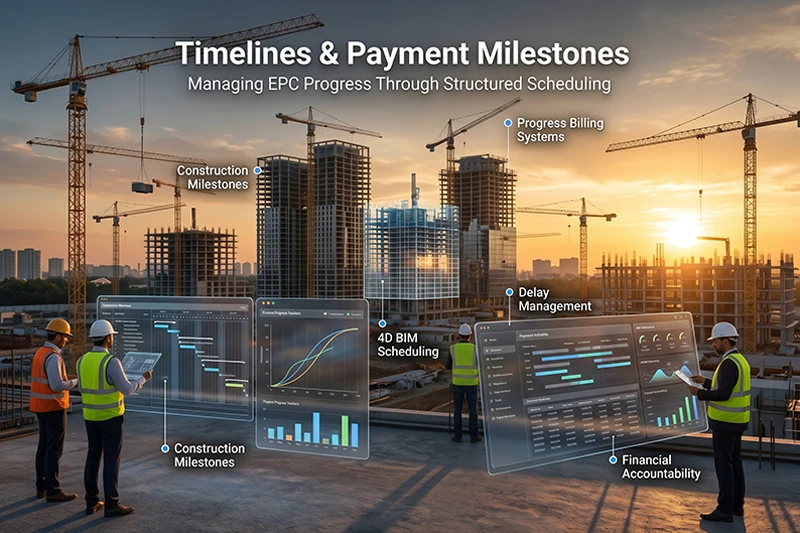
- Project Timeline and Completion Schedule – Time is one of the most critical aspects of EPC execution. All EPC Contracts in India adequately state:
- Milestones for the Project
- Construction Schedule
- Dates for Completion
- Commissioning Schedule
The owner should analyse if the timelines are reasonable and consider if there are provisions for:
- Delay Notice
- Extension of Time Claim
- Force Majeure Events
- Calculating Penalties
Frequent ambiguity regarding scheduling clauses can lead to significant disputes between parties involved in Engineering & Construction projects.
- Payment Terms and Milestones – Paying out different methods directly impact how quickly money comes in or goes out from the project, and consequently, the way a contractor performs on the project.
To create a solid EPC contract, the following needs to be included in the contract:
- Advance Payments
- Progress Billing Process
- Milestone Payments
- Retentions
- Final Settlement Conditions
As an owner, one must ensure that payment triggers are tied to measurable progress against actual work performed and not to percentage complete based upon estimates.
Using this method reduces the owners’ financial risk and increases accountability for the contractor.
- Performance Guarantee Clause – The performance security provided in an EPC India contract is essential to ensure quality delivery of works and operational efficiency.
This clause guarantees that contractors will meet the following:
- Amount of Energy that will be Generated
- Benchmarking of Quality Metrics
- Technical Efficiency Targets
- Operational Performance Standards
For example, the amount of energy being generated is often used as a reference to the benchmark energy in solar EPC projects, although an industrial plant may provide a standard for production efficiency.
In many cases, performance guarantees are backed by:
- Bank guarantees
- Liquidated damages clauses
- Warranty obligations
It is important for owners to closely examine the testing procedures and the penalty calculation methods that apply to the contractor’s performance.
- Liquidated Damages and Penalty Clauses – Liquidated damages protect the owner from the loss of money due to delay or the contractor’s failure to perform.
The contract must set out the following:
- The penalty for delay
- The maximum liability exposure
- The penalty for not meeting a benchmark
- How to calculate these amounts
These clauses must be reasonable and enforceable under the Indian Contracts Act.
- Change Order and Variation Clauses – Most construction projects will have changes in design or changes in scope during the construction process.
The effective variation clause will define:
- Approval procedures
- Cost impact evaluation
- Timeline revisions
- Documentation requirements
Without proper variation management, projects can easily breach budgets and schedules.
- Risk Allocation and Liability – A key aim of an EPC contract in India is the principle of Risk Distribution.
The contract needs to clearly identify the accountability of each party regarding:
- Price inflation on the material
- Error in the design;
- Defect in the construction of the facility.
- Conditions of the site;
- Delays due to third parties; and
Appropriate Risk Distribution reduces conflicts and facilitates smoother execution of the project.
- Warranty and Defect Liability Period – The defect liability period provides for the contractor’s responsibility for the costs associated with making any necessary repairs after completion of the project.
The owner will want to review the following:
- Warranty period
- Timeframe for responding to defects
- Obligations related to repairing defects
- Costs associated with repairing defects
This clause is very significant for EPC contracts in Indian real estate, where the quality of a product after handover (completion) of the project may have an impact on customer satisfaction.

Common Mistakes Project Owners Make While Reviewing EPC Contracts
Often, project owners will make the mistake of getting wrapped up in the cost of the project and overlook some very important operational and legal details.
Some of the common mistakes made by project owners during the review of EPC contracts include:
- Failure to recognize hidden liability clauses
- Accepting a vague scope of work
- Failing to limit penalties for delays
- Failing to define measurable performance criteria
- Failure to review the dispute resolution process
- Inadequate consideration of the impact of force majeure
Working with experienced consultants such as HLK Infra in legal and technical fields during the review of the contract will help reduce these risks.
Conclusion
In essence, the success of a construction or infrastructure project in India depends on the existence of an EPC agreement between the project owners and their respective EPCs. Each clause has an impact on quality, duration, financial risk, and performance.
Before signing an EPC contract, the project owner must examine each provision closely, looking for the engineering performance guarantees (the engineering firm performing to the project’s specifications).
A well-written EPC Contract has the potential to lower risk to both parties, increase the likelihood of accountability and success throughout the duration of the project. Additionally, by understanding the salient contract provisions of a well-written EPC Contract, the Developer can make sound decisions regarding their investments, help protect their investments through contract compliance, and ultimately have better odds of having a successful project
Read More – Design to Build Services in India
Questions People Frequently Ask
An EPC ( Engineering, Procurement, and Construction ) contract is a contract where a single contractor is responsible for the design of the project and the procurement and construction of the assets that are created as part of that design, as well as commissioning them.
Reviewing an EPC contract allows a project owner to identify areas of potential risk, clarify the responsibilities of each party, avoid potential conflict, and help ensure that the project is executed as planned.
The scope of work clause in an EPC Contract specifies what project deliverables are to be provided by the contractor, contractor responsibilities, technical standards, and obligations associated with construction.
A performance guarantee is a guarantee that the contractor will meet specified technical and operational performance criteria after the completion of the project.
Common errors made in EPC Contracts in India include a lack of clarity regarding the scope of work, unclear payment terms, insufficient penalties for non-performance, poor allocation of risk, and insufficient warranty provisions.