

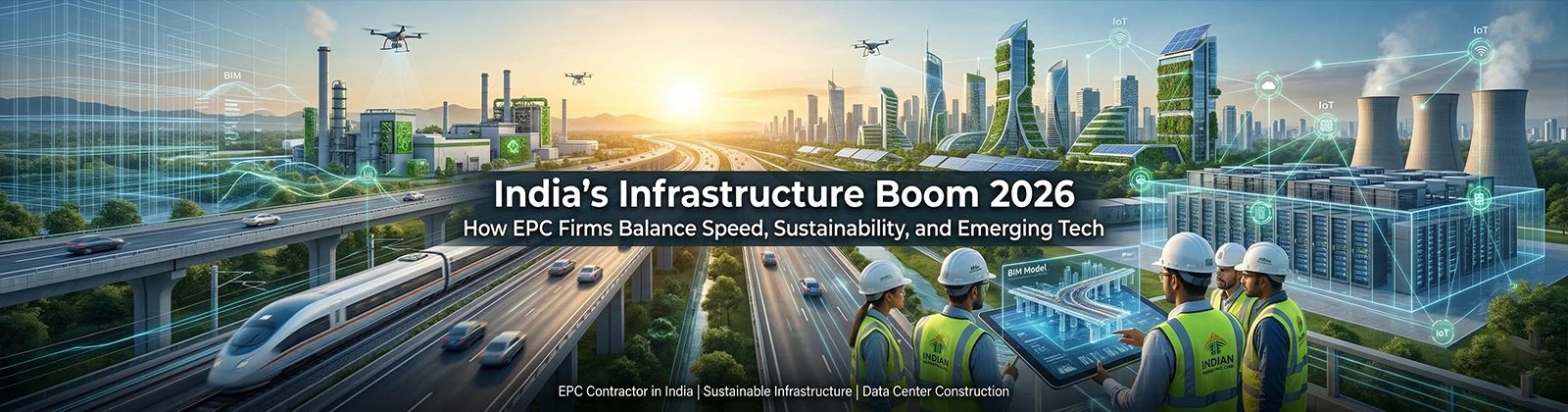
India’s big infrastructure question isn’t whether we build — it’s how fast, how green, and how smart we build.
India showed its infrastructure ambition through its Union Budget 2026-27, which established a new record by allocating ₹12.2 lakh crore for capital spending. The EPC Contractor in India now speeds up their project delivery while their main objective remains to build operational networks that use artificial intelligence and create sustainable infrastructure solutions throughout India’s developing network of public works.
Introduction
The Indian government considers the infrastructure Company in India as the primary driver of economic expansion. Therefore, it dedicated its entire Union Budget 2026-27 to capital spending, which reached an unprecedented amount of ₹12.2 lakh crore, representing a 9 to 11 percent increase over the previous year. The reports from Reuters, BBC, and The Economic Times show that current research studies focus on road and railway, logistics, clean energy, and digital network development during times of global uncertainty.
The PM GatiShakti National Master Plan directs policymakers to implement unified planning processes. The review process currently assesses 352 projects, which have a total value of ₹16.10 lakh crore, to demonstrate the transition from disjointed project execution toward unified project implementation.
The process of turning a vision into reality presents greater challenges than the creation process.
The main question centers on, “How can EPC contractors in India deliver projects at record speed while embedding sustainability and AI-ready infrastructure?”
The answer lies in the rapid development of India’s infrastructure ecosystem, which is driven by its largest players, such as HLK Infra, who adapt to operate in high-speed and high-stakes situations.
How EPC Contractors Balance Rapid Delivery of Construction Projects
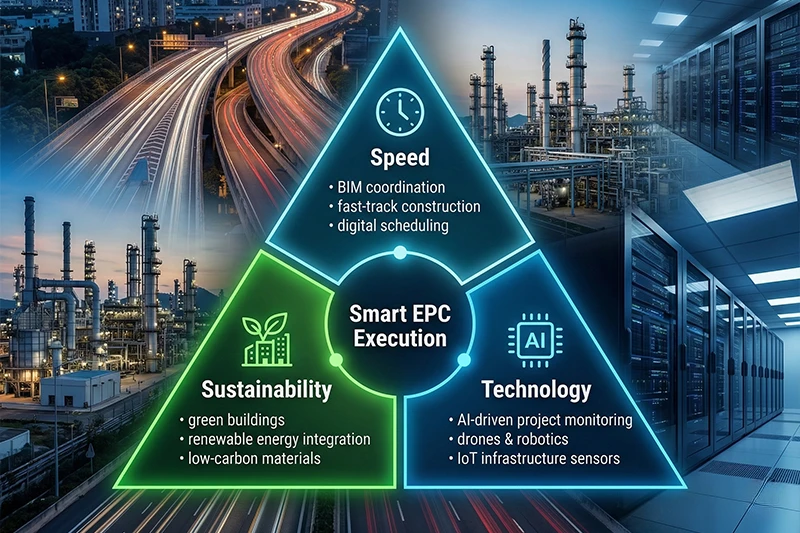
Every EPC Contractor in India needs to balance three essential priorities, which include project delivery speed, environmental sustainability, and advanced technological solutions.
- Speed:
- BIM, VDC, and digital project controls enable faster project completion through combined capabilities
- An advanced Industrial EPC Contractor in India provides complete delivery services
- India’s Mechanical EPC services and Electrical EPC Services work together through effective coordination.
- Sustainability:
- The company implements Sustainable infrastructure solutions through its operational practices
- The company operates energy-efficient systems that use low-carbon materials for their operations.
- The project design follows a lifecycle approach that aligns with climate requirements.
- Trustworthiness as an EPC company through all its operations establishes the India-based company as a reliable service provider.
- Technology Integration:
- Companies now use Physical AI, drones, and autonomous construction systems in their operations
- The system uses smart technology to monitor project status while predicting future maintenance needs.
- The infrastructure system prepared for AI use will support future industrial advancements.
- EPC Services for Technology Industries:
- Data Center Construction experiences rapid expansion throughout the industry.
- India will achieve a data center capacity of more than 2 GW, which will occur during the late 2020s.
- The system provides dependable power, cooling, and automation systems.
The Largest Infrastructure Company in India, such as HLK Infra, leads by combining rapid delivery, green execution, and intelligent systems into one unified strategy.
Government Initiatives Driving India’s Infrastructure Surge
India’s infrastructure development works from 2026 progress through effective government initiatives. The Union Budget 2026–27 allocated ₹12.2 lakh crore for capital expenditure, a 9–11% increase from last year. The country demonstrates its commitment to infrastructure development through its current project, which aims to establish both physical facilities and digital infrastructure.
1.Transportation: Better Roads and Connectivity
The National Highways Authority of India (NHAI) operates highway development and modernization projects that improve freight and passenger transportation efficiency. Seven new high-speed rail routes are planned to improve interstate connectivity. City Economic Regions (CERs) in Tier-2 and Tier-3 cities aim to decentralize industrial growth, reduce metro congestion, and build regional economic hubs.
2.Digital Infrastructure: Preparing for the Future
India is investing in data centers, AI hubs, and cloud systems. The system provides support for artificial intelligence and big data applications as well as smart city development. The combination of digital infrastructure, including the HLK’s advanced technology solutions, with industrial development and urban planning establishes India as an economy prepared for future opportunities.
3.Integrated Planning with PM GatiShakti
The PM GatiShakti National Master Plan covers 352 projects worth ₹16.10 lakh crore. The system creates a unified planning system that helps reduce duplicate work between different government departments. The combination of GIS mapping and state cooperation leads to reduced logistics expenses. States can access interest-free loans up to ₹5,000 crore for faster execution.
4.Sustainable Growth
The government promotes renewable energy projects together with hybrid systems and urban energy-efficient initiatives. The system enables private companies to participate in projects through public-private partnerships, which include loan guarantees, resulting in faster project execution.
5.Economic Impact
The government projects generate multiple job opportunities while boosting the need for steel, cement, and logistics services, which will drive growth in local markets. Additionally, the projects support the Viksit Bharat mission, which aims to create inclusive and robust development through various architectural and infrastructural solutions, including the AEC staffing solutions provided by HLK Infra.
Government initiatives accelerate the infrastructure surge in India through the EPC and turnkey projects, along with PPP partnerships with private infrastructure companies like HLK Infra, that enhance the efficiency and cost optimisation. HLK Infra proudly contributes to the development of the nation by delivering the most reliable infrastructure solutions and actively supporting India’s rapid infrastructure development and transformative growth.
The Triple Challenge in EPC Execution
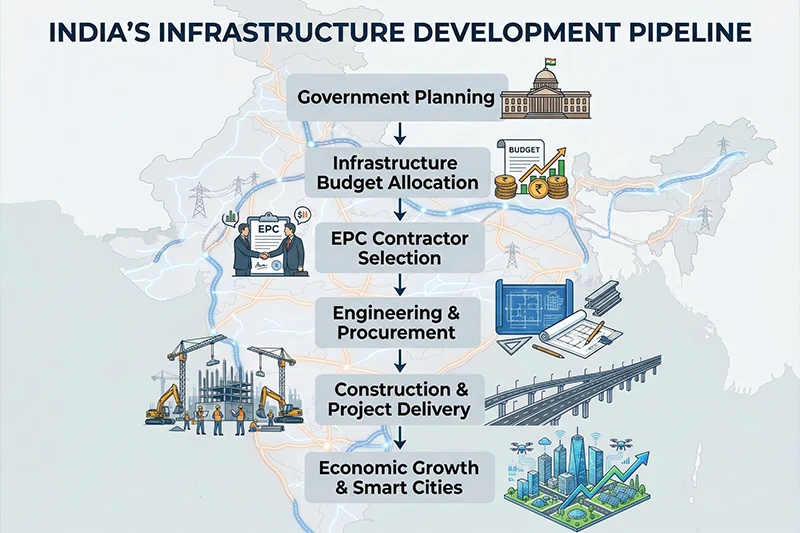
The EPC Contractors in India need to achieve three goals because they must complete their projects according to three requirements: they need to finish work quickly while maintaining sustainable practices and using all available technological advancements. The achievement of projects needs to find the perfect balance between these three requirements by the year 2026.
- Speed – Speed is essential for success. Tight timelines show how industry delays create economic problems for highways, high-speed rail corridors, data centers, and industrial hubs. Every postponed milestone increases labor costs, disrupts supply chains, and reduces the projected economic multipliers of these projects. The project needs efficient scheduling together with optimized procurement and real-time coordination among stakeholders to achieve both cost management and sustained investor confidence.
- Sustainability – India needs to implement low-carbon materials and energy-efficient designs and waste-reducing techniques because of its net-zero targets and climate resilience objectives, and challenges from urban environmental conditions. To create environmentally sustainable infrastructure development, a trusted EPC company in India, like HLK Infra, implements environmental practices throughout its entire process from procurement to construction.
- Advanced Technology – The third pillar is emerging technology. The Physical AI revolution transforms project execution through robots, autonomous material movers, and drones, together with BIM/VDC and Internet of Things-based predictive maintenance systems. These technologies create safer workplaces and minimize rework costs while delivering current information about project progress and potential hazards. EPC Contractors must use these technologies to achieve better precision and efficiency and maintain their market position.
The three elements need to work together because any imbalance between them creates two major threats that lead to project costs exceeding budgets, environmental damage, and new technologies taking longer to be integrated into projects.
How Leading EPC Firms Like HLK Infra Are Adapting
The EPC Infrastructure Company in India, which leads the market, implements new execution methods because its infrastructure projects require more complex systems. HLK Infra implements technology, sustainability, and delivery certainty as essential elements of its business operations.
The transformation process requires businesses to adopt new technologies. HLK Infra uses BIM and VDC technologies to improve its project visualization, clash detection, and scheduling accuracy. The EPC Services for Technology Industries enable teams to predict construction site limits while they create plans for material distribution and risk management before they start building. This method creates major time and expense savings in situations that involve difficult environments or urgent assignments.
HLK Infra supports sustainability through its commitment to clean energy and future-proof assets. The company provides essential information about economical nuclear EPC solutions, which demonstrate how affordable and scalable energy systems support India’s energy transition objectives. The company develops smart buildings and technology facilities through project design, which merges energy-efficient systems with optimized resource usage and sustainable long-term operations.
HLK Infra uses its “delivering certainty” approach to achieve fast results through unlimited engineering and procurement planning and comprehensive risk management, which enables the company to produce controlled results during difficult infrastructure projects. The method becomes essential for industrial operations because they depend on continuous production, which makes any downtime costly.
The future will see autonomous systems integrated with Physical AI technologies, which include robotics and drone inspections, and AI-based monitoring systems to improve site operations while boosting safety levels. The system achieves its purpose through the process of combining two different elements.
Conclusion
The year 2026 marks a pivotal year for India’s infrastructure transformation, where record investment meets the urgency of sustainability and AI-driven innovation. Every EPC Contractor in India needs to achieve success through three essential requirements, which include maintaining project speed while implementing environmentally friendly methods and adopting digital technologies.
HLK Infra demonstrates this transformation by using technology to develop solutions that prepare them for future work. India has established itself as a worldwide authority in developing intelligent systems that create robust infrastructures through artificial intelligence technology.