


A poorly chosen EPC contractor could severely impact an industrial project even before construction begins or when no foundation has yet been laid. This decision is extremely important for owners of projects within India due to the difficulty of working under complicated mandates, multi-disciplinary scopes, and compressed timelines. This document will guide how to choose EPC contractors in India at each part of the selection process, from EPC shortlisting in India to final bid evaluation.
Different Risks Associated with Selecting EPC Contractors for Manufacturing
Industrial facilities such as refineries, power generation plants, pharmaceutical manufacturing plants, chemical processing facilities, and data centres have a different level of risk from commercial or residential building projects. The interdependencies of the scope of work are highly interrelated. A delay in civil works can push back mechanical construction, which in turn will delay when electrical work can be completed. If the contractor is not selected correctly, the costs to the project will not only include cost overruns, but also lost production, regulatory penalties, and damage to the contractor’s reputation.
Selecting an appropriate EPC contractor for industrial facilities in India requires evaluating multiple aspects and stages, as opposed to just comparing prices. The selected EPC contractor evaluation in India must have demonstrated that they can successfully execute a large number of projects across multiple disciplines, have financial stability, and have the resources necessary to manage a project from its conceptual stage to its commissioning stage.
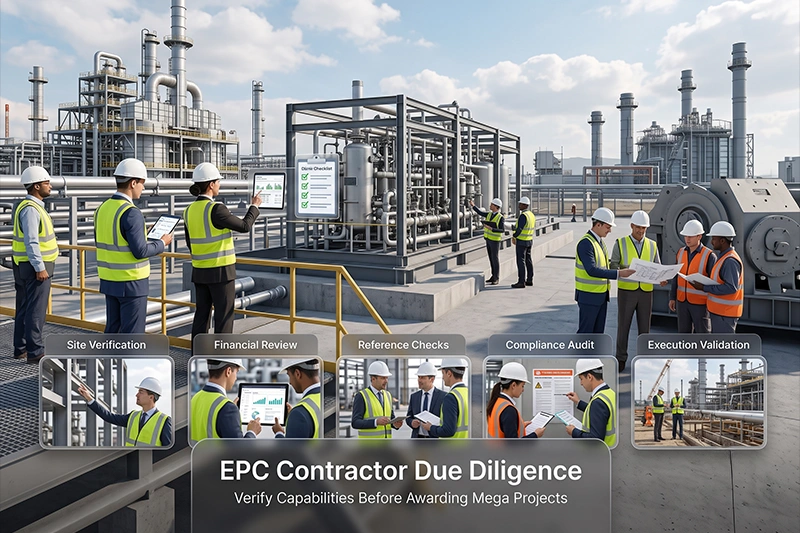
Stage 1: Developing the EPC Contractor Checklist India
An owner must prepare a checklist for the EPC contractor in India before releasing any project-specific tenders or requests for quotations (RFQs). The EPC contractor checklist in India is used as a basis for evaluating EPC contractors throughout the entire evaluation process. Key areas of consideration when creating the EPC contractor checklist for India are:
References from previous projects: Has the contractor delivered previous projects with similar characteristics to your type of project? For example, is a petrochemical EPC contractor the right choice for a pharmaceutical project?
- Engineering capabilities: Does the contractor have an engineering team capable of delivering detailed engineering? If not, will they need to outsource this work? A contractor that heavily relies on outsourcing for detailed engineering will have high risks related to coordinating all of the engineering activities.
- Financial capabilities: A contractor’s financial capabilities (e.g., balance sheet strength, liquidity ratios, and working capital position) will directly impact a contractor’s ability to mobilise for a project and continue executing the project without being delayed by non-payment.
- QHSE track record: As part of your initial screening process for industrial projects, you will want to review a contractor’s lost time injury rates, ISO certifications, and environmental management systems.
- Procurement infrastructure: A contractor’s procurement infrastructure and vendor base will determine whether long lead items will be proactively managed or reacted to.
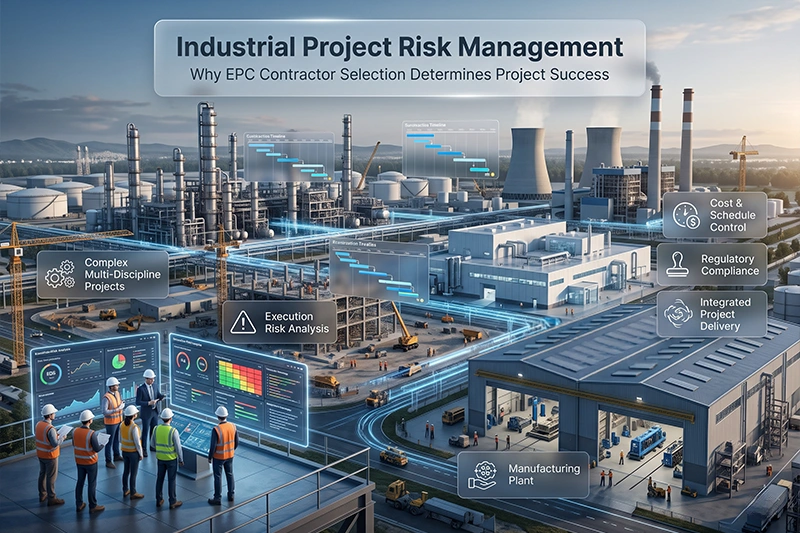
Stage 2: EPC Shortlisting India: Narrowing the Field
EPC shortlisting in India generally commences with an RFQ or EOI. This stage qualifies the applicants based on their documented capabilities rather than the pricing of their offers. The resulting shortlist will usually contain approximately three to five firms, all of which will be invited to respond (i.e., submit) with a full technical and commercial proposal.
The EPC RFQ within India should require the following items from each firm:
- The company profile, with references to relevant projects (capacity, technology, geography);
- Curriculum vitae for key personnel;
- Organisational charts for the proposed team;
- QHSE metrics from past projects;
- Independent financial statements from the last three years;
- Preliminary methodology statement regarding project scope.
Firms that qualify based on their pricing at this stage will consistently underperform during delivery.
Stage 3: The EPC Tender Process India: Structuring the RFP
The EPC tender process in India for industrial projects is a three-phase, multi-envelope process. The structure of an RFP separates technical from financial submissions to eliminate financial impact on the technical assessment. It is important that “the limits of what is being requested” are clearly defined and delineated. The ambiguity around the limits of scope is the primary cause of variances in the Indian EPC contract.
A robust RFP for the EPC tender process in India should contain the following:
- A Basis of Design and Performance Specifications
- Definition of Battery Limits and a responsibility matrix for interfaces and ownership
- Schedule milestones and a liquidated damages provision
- Lump sum price with a defined breakdown structure
- Mandatory subcontractor disclosure and approval requirements
Stage 4: EPC Bid Evaluation India: Beyond the Bottom Line
When evaluating bids for construction projects in India (EPC Projects), it is important to use a consistent structure for assigning scores. To evaluate complex industrial projects, a technical capability should account for 60 to 70% of the score, while a commercial aspect of the proposal accounts for 30 to 40% of the score. Price alone should never determine a successful bidder. If an EPC contractor’s lowest bid is from a company with a poor track record for providing quality services, then you are at risk of being disappointed due to poor performance.
The technical criteria used to evaluate bids for an EPC contract in India include the following:
- Project Execution Methodology: Are the contractor’s methods specific to the construction of this particular project, or are they generic templates?
- Key Personnel: The CVs of the project manager, engineering leads, and construction manager should demonstrate that each of these individuals has worked on projects of the same technical complexity as this specific project.
- Schedule Credibility: Does the contractor have a realistic schedule, and has the schedule been developed with proper sequence and resource availability?
- Risk Register: Has the contractor identified project-specific risks and provided reasonable mitigation plans for dealing with those risks in their proposal?
Stage 5: EPC Contractor Due Diligence India: Verify Before You Sign
The EPC contractor evaluation in India is being overlooked by the majority of project owners when timelines are tight, but when things go wrong with a project, this will be one of the biggest regrets for them. Due diligence in this stage includes reference checks on prior customers (not references selected by the contractor), visiting similar completed or ongoing projects, verifying statutory registrations and the validity of the contractor’s licence, as well as reviewing litigation and arbitration history.
Additionally, financial due diligence should also include looking beyond the submitted balance sheets. By obtaining credit ratings, banker references, and payment history of the contractor with subcontractors and vendors, it will help show how much effort the contractor has put into managing their supply chain. Consequently, it is a critical indicator of how consistent the execution of large industrial projects will be.
EPC Contractor Selection Criteria India: The HLK Infra Standard
Elements that are specific to EPC contractor selection criteria in India can be identified and evaluated through a structured process, and HLK Infra provides both elements. With extensive experience throughout multiple EPC project types in the energy, utilities, and process sectors, HLK Infra has established a project delivery framework that is correlated with the level of detail required for such complex projects in India.
The approach of HLK Infra to the evaluation of EPC contractors in India is built upon three pillars:
- Technical Transparency (through comprehensive scope definition and engineering accountability from day one),
- Financial Discipline (through structured milestone-based payment models with performance-linked provisions), and
- Multiple Levels of Execution (through dedicated and competent EPC teams with experience in the relevant sector, rather than sharing resources across projects).
For the Project Owner evaluating prospective EPC Firms in India through formal procurement with other EPC Firms, HLK Infra provides a profile that would enable the Project Owner to conduct their due diligence process, including audited financials, verifiable project references in similar sectors, adherence to QHSE-certified processes, and a project management methodology that is capable of delivering complex multi-discipline projects consistently.
Conclusion
Choosing an EPC contractor for an industrial project in India is not a purchasing decision; it is a decision about managing your risks. At each step of the process, from EPC shortlisting all the way through from EPC bid evaluation to EPC contractor evaluation and selection in India, each stage protects from project execution failure. The EPC contractor selection criteria India for industrial projects (EPC contractor criteria) in India have been developed for very good reasons: industrial projects cannot afford to have poorly selected contractors. HLK Infra, one of the best EPC firms in India, has been built to meet this high standard.
Questions People Frequently Ask
Execution experience in the relevant sector and financial viability are the two key criteria that must be established before considering price competitiveness; however, demonstrable capabilities of executing industrial sectors with similar scope are still a vital component and consideration.
The EPC tender process in India contains two stages, both technical and commercial aspects of the same project have been separated into different envelopes at the same time, and the scope of each envelope is defined through performance specifications rather than bills-of-quantities.
An EPC RFQ in India should include, among other things, past project references, CVs for key personnel, information regarding in-house engineering resources, QHSE stats, audited financial statements for three years, and a preliminary outline of the proposed methodology to complete the project.
EPC bid evaluations in India should include a weighted scoring model where technical criteria make up 60-70% of the total score, and all capabilities and methodologies have been evaluated prior to considering the commercial terms.
Due diligence on EPC contractors performs an important risk assessment of the contractor’s execution performance and is essential to expose risks associated with the execution of the project that may have been concealed during the formal bidding.