

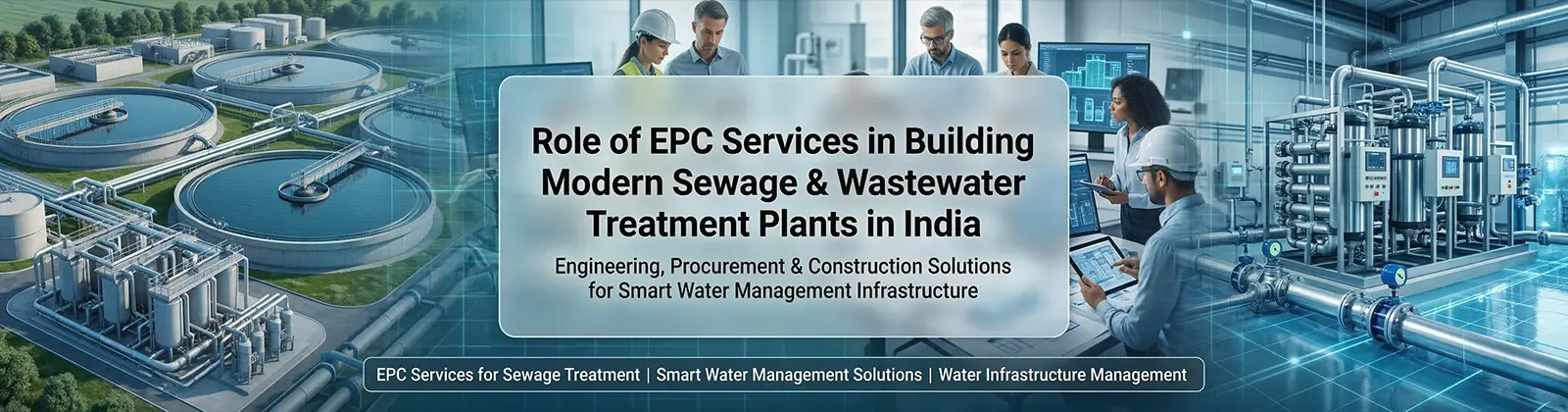
The EPC services for sewage treatment play a key role in building modern sewage and wastewater treatment plant services in India. Companies like HLK Infra provide smart water management solutions in India that help upgrade infrastructure while creating permanent water systems. The services provide support for industrial wastewater treatment and rural water supply systems to achieve Zero Liquid Discharge (ZLD) standards, while also monitoring pipelines and improving smart city water management.
Introduction
India’s urban areas possess a significant opportunity to improve their wastewater treatment systems through smart water management solutions. Indian cities generate more than 72000 MLD of wastewater, yet only 28-50% receives proper treatment. The untreated wastewater is disposed of into rivers, lakes, etc that can cause water contamination that can pose a health hazard to human beings. Through the existing projects that aim to enhance wastewater treatment facilities, India can establish an eco-friendly water management system through advanced solutions, which will also enhance public health while transforming this environmental challenge into an opportunity for sustainable development.
The demand for modern WTP and STP company in India has never been greater. India has made significant investments in sewage infrastructure through its Namami Gange Program and Atal Mission for Rejuvenation and Urban Transformation (AMRUT) initiatives. These initiatives have led to the addition of thousands of MLD to the national treatment capacity. The current pace of urbanisation in India surpasses existing treatment capacity, which shows that the country needs to develop more sustainable and efficient water treatment technologies for its future.
The EPC (Engineering, Procurement, and Construction) services for sewage treatment play a crucial role at this point. Companies like HLK Infra provide EPC services for water management in smart cities and act as single-point responsibility providers, which helps them deliver advanced STPs that fulfil strict requirements while maintaining dependable functionality.
HLK Infra stands as one of the top companies that delivers complete EPC solutions for sewage treatment plants. We focus on complete water treatment solutions, delivering through an establishteced track record in pipeline monitoring systems. The company has developed trust with clients throughout India by delivering complete water management services, which include design, development and construction of operational facilities.
Understanding the EPC in Sewage and Wastewater Treatment
The process of treating sewage and wastewater establishes the basic definition of EPC, which operates as a complete project management system used in sewage and wastewater treatment facilities. The EPC model involves three key stages:
- Engineering: This stage involves the design and customisation of the treatment system. It includes developing detailed plans for the sewage treatment process, selecting appropriate technologies (like SBR—Sequencing Batch Reactor or MBBR—Moving Bed Biofilm Reactor), and tailoring the design to meet the specific needs of the site and wastewater composition.
- Procurement: During this phase, the required components, machinery, and equipment are sourced. The system needs essential components that include pumps, membranes, filtration systems, and other vital equipment. The selected components will provide operational excellence and compliance with performance standards and mandatory regulations.
- Construction: The final phase encompasses the physical building and installation of the plant. The project requires civil engineering work, mechanical engineering work, and electrical engineering work to build tanks and reactors, piping systems, and power supply installations. The plant will complete testing and calibration following commissioning to confirm its design specifications before transferring control to operational staff.
The EPC model is particularly well-suited for STPs because it needs multiple engineering fields that include civil engineering, mechanical engineering, electrical engineering and process engineering to work together in complex ways. The Central Pollution Control Board (CPCB) establishes strict environmental standards which wastewater management systems must adhere to, thus requiring construction and operation activities to follow detailed guidelines.
HLK Infra delivers comprehensive sewage treatment services which use advanced technology to support both urban and municipal development projects. HLK Infra manages all project stages from detailed design through advanced treatment processes to final handover, ensuring each project achieves regulatory compliance and operational success through dependable and effective systems.
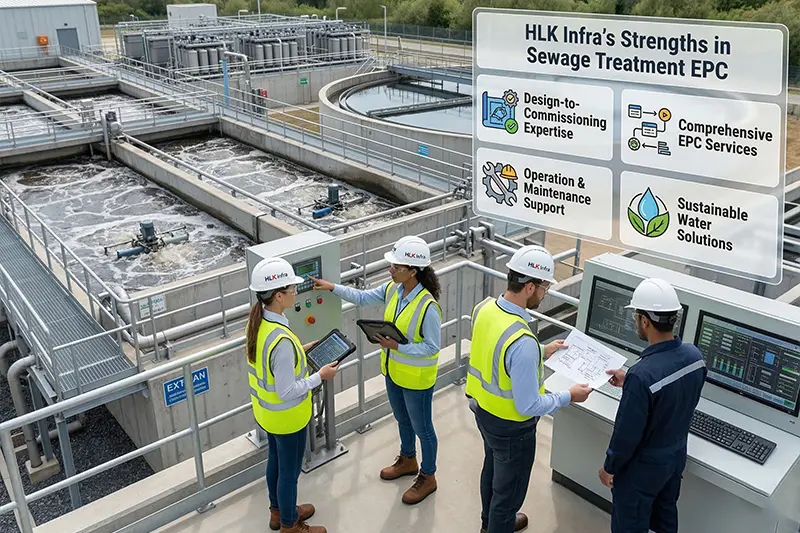
HLK Infra's Strengths in Sewage Treatment EPC
HLK Infra, as one of the Industrial Wastewater Treatment Companies in India, has built a strong reputation in EPC Services for sewage treatment and wastewater treatment projects in India. The company provides dependable solutions which cover all stages from design through to final commissioning. The company focuses on three main objectives, which include achieving operational efficiency, developing environmentally sustainable solutions and creating systems that will function effectively throughout their operational lifespan.
HLK Infra develops effective smart water management solutions which can be expanded to meet the rising need for advanced sewage treatment facilities. The company uses its technical skills together with contemporary water management systems to fulfil all project needs.
- Design-to-Commissioning Expertise – HLK Infra develops customised water treatment plant services in India, which achieve operational efficiency. Projects develop through designs which match site conditions and treatment needs of each location.
Key highlights include:
- Site-specific plant design
- Advanced technologies, which include SBR and MBBR
- Operate with high energy efficiency
- Compact plant layouts which suit metropolitan environments
The solutions enhance treatment performance while decreasing operational expenses.
- Comprehensive EPC Services – HLK Infra delivers complete EPC services for sewage treatment plant projects. The company manages every stage of the project lifecycle.
The process includes:
- Feasibility studies and technical assessments
- Detailed engineering designs and process development plans
- Procures high-quality pumps, blowers, and other essential equipment
- Construction work involves civil engineering, mechanical work and electrical installation
- Plant setup work and testing activities
- Testing and validation of system performance
The integrated system approach produces project work that finishes ahead of schedule while maintaining high-quality standards.
- Post-Handover Support and O&M – HLK Infra provides operation and maintenance (O&M) services, which continue after the project ends.
Support services include:
Monitoring of system performance through ongoing system assessment
Conducts maintenance activities, which include equipment restoration and system upkeep
Develops process improvements which enhance treatment operations
Maintain plant operations through reliable performance, which produces stable water quality.
- Strong Focus on Sustainability – HLK Infra focuses on developing solutions which protect the environment. The company supports water reuse and energy efficiency in Sewage & Wastewater Management.
Sustainability initiatives include:
- Reused treated water for landscaping and industrial purposes
- Operate with energy-saving equipment and operational systems
- Follow environmental regulations and adhere to discharge standards.
Real-World Impact of Water Management System
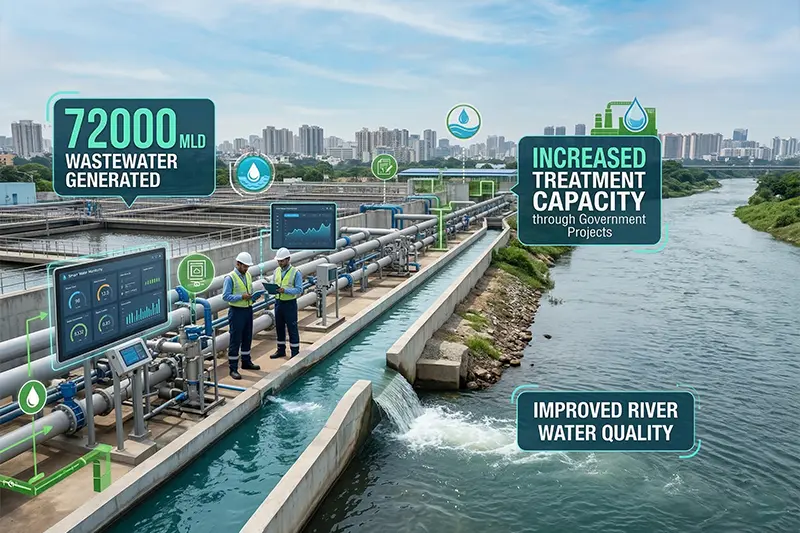
India faces a major wastewater treatment challenge. The country produces more than 72000 MLD of sewage according to reports from NITI Aayog and the Central Pollution Control Board (CPCB). The actual wastewater treatment rate stands at 28%, which results in 72% of wastewater entering water bodies without treatment. The situation requires immediate solutions through modern sewage treatment systems.
India has established multiple Sewage & Wastewater Management initiatives to close this existing gap. The Namami Gange Programme serves as one of the main smart water management solutions. In 2025, approximately 25 sewage treatment plants began operations, which increased their treatment capacity by almost 530 MLD. These projects help decrease pollution levels in both the Ganga River and its adjacent urban regions.
The Atal Mission for Rejuvenation and Urban Transformation (AMRUT) initiative stands as another vital program. The program focuses on improving urban water supply and sewage infrastructure, as well as the infrastructure water supply for rural India. AMRUT projects construct sewer networks and establish new sewage treatment plants through EPC delivery systems. The projects have enabled Indian cities to achieve treatment capacity increases of thousands of MLD.
Multiple cities throughout India have gained advantages from their implementation of extensive sewage treatment systems. Cities such as Delhi, Gwalior and Navi Mumbai have established modern STPs. The plants work to decrease river pollution while enabling treated water to be reused in landscaping and industrial applications.
The projects rely heavily on turnkey EPC execution because it serves as their primary operational method. Under one contract, EPC contractors oversee all aspects of design, procurement, construction and commissioning activities. The system establishes better control systems, which lead to shorter project timelines.
Companies like HLK Infra provide their support for this transformation. HLK Infra provides water management system services which enable reliable sewage treatment and water infrastructure project delivery. The company delivers its services through two main areas, which include efficient execution and sustainable water management solutions.
The actual cases demonstrate that turnkey EPC projects work to speed up wastewater treatment development across India. The initiatives enable pollution control while they enhance water reuse capabilities, and they support the country’s efforts to achieve long-term water security.
Conclusion
India’s growing urban population creates a need for better sewage and wastewater treatment systems to meet rising demands. Modern sewage treatment plants function as vital components which help decrease environmental pollution while enabling sustainable water resource management. EPC services for sewage treatment deliver dependable project execution by handling design work, procurement activities, construction processes and commissioning tasks through one contractual agreement.
The Namami Gange Programme, together with other government programs, continues to increase wastewater treatment capabilities throughout India. The Press Information Bureau (PIB) 2026 reports that 218 sewage projects have commenced operation with a total permitted capacity of 6610 MLD.
Through collaboration with experienced EPC providers such as HLK Infra, we establish dependable STPs which will deliver effective project execution and sustainable system operation. HLK Infra is not just meeting India’s current water treatment needs but also setting the stage for a more water-secure future.