

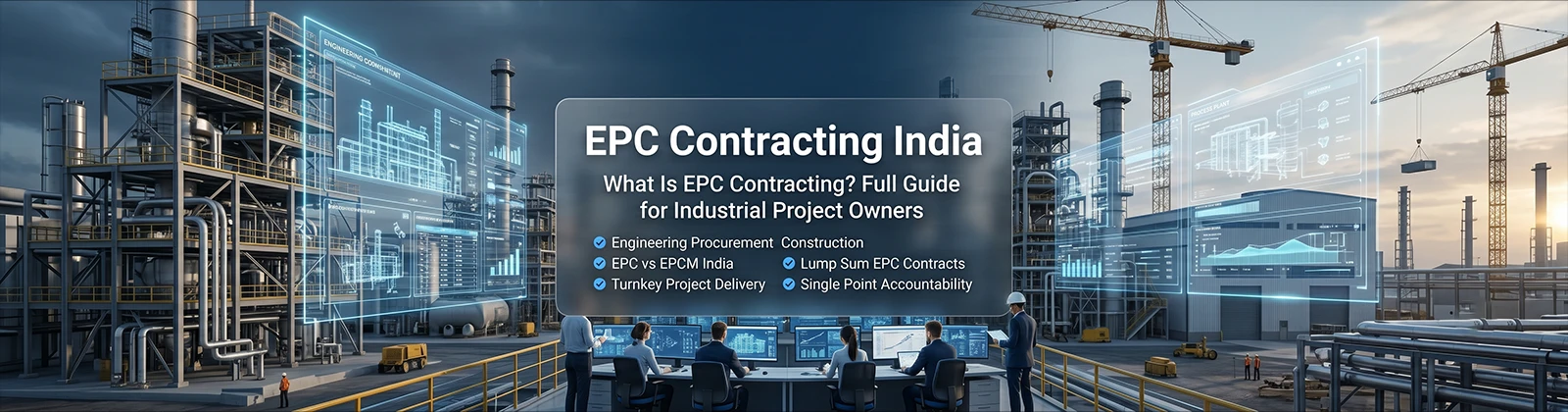
Industrial development projects within India have become increasingly complex through high-quality joint efforts towards developing from a single point of accountability for all involved. EPC contracting in India is now one of the most effective options for delivering successful projects.
Whether you’re designing and constructing a manufacturing facility, warehouse, processing plant, infrastructure, or utility project, you can learn more about the EPC model India by reference to the materials below, and ultimately, reduce your risk, improve your ability to control costs, and speed your time to market through understanding an EPC project.
This guide will help you understand what constitutes an EPC contract in India, how an EPC project functions, the most significant duties and responsibilities of an EPC provider, the typical phases of an EPC project, potential risks, and why the success of the launch of any EPC project within India relies on the expertise of organisations, such as HLK Infra.
What Is EPC Contracting?
An EPC contractor handles every aspect of the construction process, from designing and engineering to procuring materials, building the project, testing, and commissioning the completed product. An EPC company is responsible for all phases of a construction project.
In Indian markets, an EPC contract is considered a single-responsibility contract whereby the single contractor will have responsibility under the contract to do all designs, builds and operate all aspects of a project from conceptualisation to commissioning.
The EPC contract model is directly associated with the EPC turnkey concept in India. With an EPC turnkey agreement, a contractor builds a project from start to completion and gives it to the owner as an operational facility simply by using a key to start generating income. Under the EPC model in India, and the traditional approach to construction where there is a separation of procurement, design, and delivery, the proposal allows HLK Infra to become the single source of accountability for all aspects of the project and to operate effectively as a central hub for all components of the project.
EPC vs EPCM India: Understanding the Crucial Distinctions
While the name has some similarity or sound identical, their legal, financial, and risk structures are fundamentally different.
Feature / Dimension | EPC (Engineering, Procurement, Construction) | EPCM (Engineering, Procurement, Construction Mgmt.) |
Contractual Relationship | Single point of contact; the owner has one contract with the EPC firm. | Multiple contracts; the owner directly signs contracts with suppliers/builders. |
Financial Risk | Borne by the contractor via a fixed price or lump sum cap. | Borne entirely by the project owner, professional services are fee-based. |
Legal Liability | Contractor is liable for project delays, performance, and defects. | Management firm is only liable for professional negligence, not contractor defaults. |
Owner Management | Hands-off; minimal day-to-day administrative oversight required. | Hands-on; requires a dedicated internal team to manage multiple vendors. |
In comparing EPC vs EPCM in India, there are distinct differences in how the contractor and client share risk associated with the projects. EPCM firms operate solely as agents/consultants to their clients and are not responsible for any financial liability incurred through entering into a variety of contracts directly with various construction companies; therefore, all financial and liability risk is borne by the owner.
On the other hand, EPC contractors take on the operational burden and financial risk associated with the construction project, providing a predictable cost and a single point of accountability.
The EPC Lump Sum Contract as The Financial Backbone
The EPC lump sum contract in India is the primary business engine generating this business model for this industry in India. Thus, such a proposal is derived from the contractor’s ability to offer a complete, singular price for fulfilling the agreed-upon scope of work. Unless the owner requests changes to the project’s scope, this price is fixed regardless of fluctuating marketplace costs or unforeseen field conditions.
The fixed pricing format provides tremendous benefits in budget planning by corporations and also by lenders when these companies are implementing project financing. Because EPC lump sum contracts minimise financial risk and uncertainty, banks and financial institutions in India prefer to use this pricing structure to reduce the decision risk of project owners obtaining debt financing or construction loans. HLK Infra uses modern, advanced estimation methods to produce reliable fixed pricing for projects, which allows stakeholders to have 100% visibility and confidence in their capital expenditures from the very first day.
Lifecycle of an Industrial Build: EPC Project Phases India
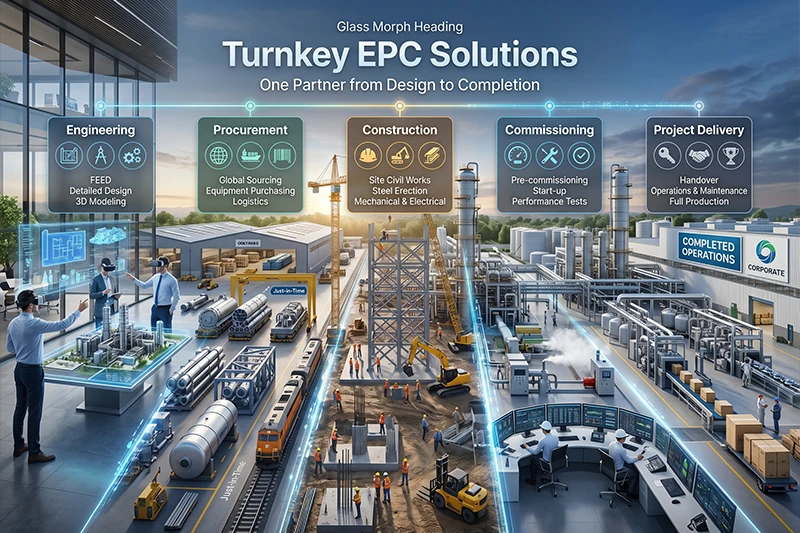
An industrial asset goes through very discrete but heavily interdependent stages. The normal phases of an EPC (Engineering, Procurement, and Construction) project phases in India can be assigned to four main chronological procedures.
- Detailed Engineering & Design – The conversion of the Owner’s conceptual requirements into precise designs via the development of Construction Documentation (for example): Engineering Drawings, Architectural Drawings, Construction Data Sheets, and Equipment Data Sheets. This stage includes detailed designs for Process, Civil Engineering, Structural Fabrication Drawings, Electrical Wiring Diagram, and Equipment Layout.
- Project Procurement Process – After the designs are completed, the actual project materials and equipment sourcing start globally and locally. The material sourcing process requires importing raw materials and specialised equipment, plus providing sourcing assistance for pipe and electrical systems. In providing EPC procurement project materials, stringent vendor qualifications, thorough inspection, and strict logistical coordination will help to ensure that all necessary items arrive at the project site when they need to be present in order to support the construction process.
- Construction & Installation – The actual construction include creating and building structures through building materials, including earth, concrete, steel, lumber, fiberglass, aluminum, and other types of materials. This tightly controlled scheduling of on-site activities and subsequent tracking of on-site activities.
- Commissioning & Handover – The pre-operational testing/commissioning phase includes detailed testing of all electrical and mechanical systems and an Integrated Testing of the whole facility under all operating conditions. Once commissioning is complete, ownership of that new facility will transfer to the client from the contractor.
The Mandatory EPC Contractor Responsibilities India
According to the standard EPC contractor model in India, the contractor takes on a multi-faceted role that incorporates:
- Regulatory and Statutory Compliance: Maneuvering through India’s multi-layered regulatory systems to secure environmental clearances, factory inspection approvals, and local municipality approval.
- Control of the supply chain: The EPC contractor is responsible for controlling logistics and handling import/export duty as well as protecting the project from price variance for materials.
- HSE (Health, Safety, and Environmental): Through a commitment to HSE, we are focused on a no-accidents philosophy while constructing a project in accordance with internationally accepted health and safety standards.
- Quality Assurance: We will conduct various types of non-destructive testing (NDT), testing for compressive strength of the concrete, and inspecting to ensure that the appropriate welding standards have been followed to ensure the asset will last for years to come.
- Subcontractor Management: Interviewing, hiring, and supervising specialist trade crews, and keeping the project owner from being caught up in labour disputes.
When an experienced partner like HLK Infra takes on these responsibilities, it enables project owners to spend their time focusing on their core business functions and not be impaired by daily construction management activities.
Navigating The EPC Project Risks India
Although most of the risk is transferred to the contractor by the model, there are still many specific challenges to executing heavy industrial projects in India. Some key EPC project risks present in India include:
- Regulatory and Land Acquisition Delays: TThe inability to secure or obtain required statutory clearances can halt construction progress on-site.
- Commodity Price Volatility: If there are large increases in steel, cement, or copper prices, fixed-price contractors will experience a significant financial burden, and this will create difficulties in completing construction.
- Local Weather and Geo-technical Disruptions: Unexpected soil conditions or excessive rainfall during the monsoon can cause delays in the construction project according to the planned construction schedule due to adverse local weather conditions in geotechnical terms.
To mitigate risk, strong project owners will focus on:
- Comprehensive pre-project planning
- Detailed soil mapping
- Choosing an experienced EPC partner who is well-capitalised and capable of accommodating and managing the effects of macroeconomic turmoil.
Conclusion
Using the EPC contracting India model, project owners have access to a streamlined way of expanding their industrial presence. This model combines the advantages of single-point accountability, predictable pricing, and professional execution to reduce the cost of friction that has historically existed with building infrastructure in India.
If you are considering developing another industrial facility, then choosing the right partner to help you with your entire project is critical. HLK Infra provides a complete range of EPC services customised for each client’s specific regulatory, geographic and economic conditions within India.
Whether it is the initial engineering assessment or the final commissioning of your project, HLK Infra guarantees that every stage of the process will be conducted efficiently and meet internationally accepted standards.
Questions People Frequently Ask
The acronym EPC stands for Engineering Procurement and Construction. It is a form of contract between two parties whereby one party assumes complete responsibility for the performance of all of its obligations to construct the completed asset.
A lump sum-based EPC contract provides project owners with absolute certainty as to the total cost of constructing the project. The contractor has agreed to deliver the complete scope of work under the terms of the lump sum EPC contract, thereby shielding both the contractor and owner from potential price increases on materials and cost overruns in construction.
While the terms EPC and turnkey are often used synonymously, there is a historical connection regarding the meaning of each term and contract. The EPC term refers to three elements of the project design, procurement, and construction, while the turnkey term is usually only related to the value of an asset that has been completed.
The EPC contract model places financial and operational risks solely on the contractor, whereas the EPCM contracting method places financial and operational risk with the project owner. The EPC method provides project owners with greater predictability of the total cost of the project in an unpredictable economic environment.
An EPC procurement process in India includes the finalization of a technical Design, qualification of potential suppliers, issuance of purchase orders, quality inspections, and the coordination of logistics for the delivery of equipments and the other required materials to the construction site on time.