

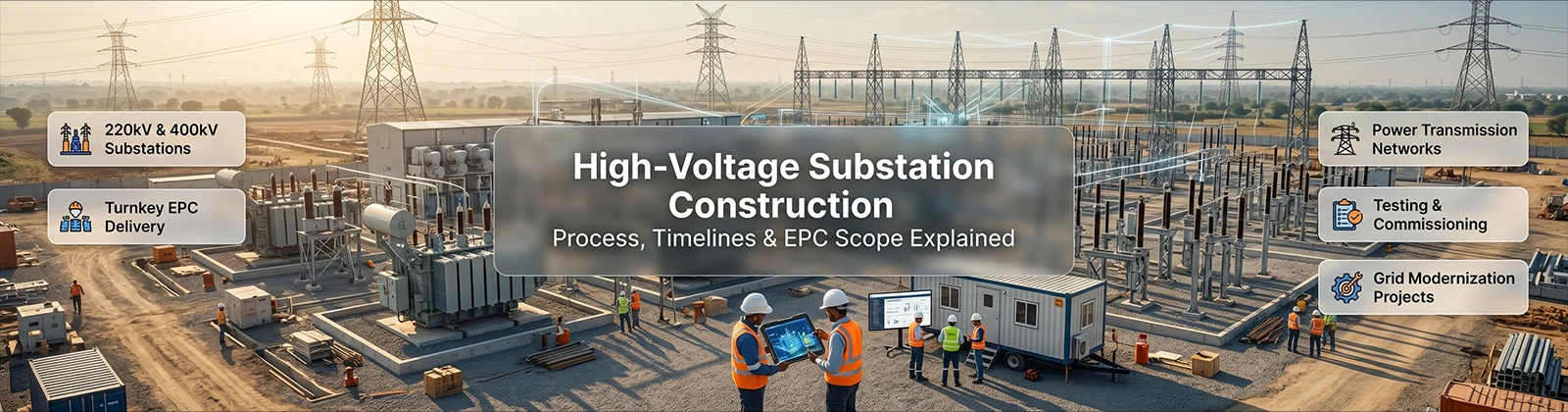
The high-voltage substation construction in India really needs detailed planning, engineering, procurement, and execution to keep power transmission and distribution dependable. This guide walks through the power substation construction process, the usual project timelines, and the role of Substation EPC Services in India, from start to finish. It also touches on electrical infrastructure EPC services, turnkey substation projects in India and substation construction service in Delhi needs that utilities and industries often mention.
Understanding high-voltage substations
A high-voltage substation is one of those kinda key parts in the power transmission system that changes electrical voltage levels, manages how the power moves, and also guards the grid against faults. In practice, these substations are built to deal with the high-voltage electricity that comes from power plants, before it is routed across long distances.
Most high-voltage substations usually run at voltage levels like:
- 132 kV
- 220 kV
- 400 kV
- 765 kV and above
As India’s power infrastructure keeps expanding, the demand for newer substations that can support renewable generation and heavy industrial demand is still increasing.
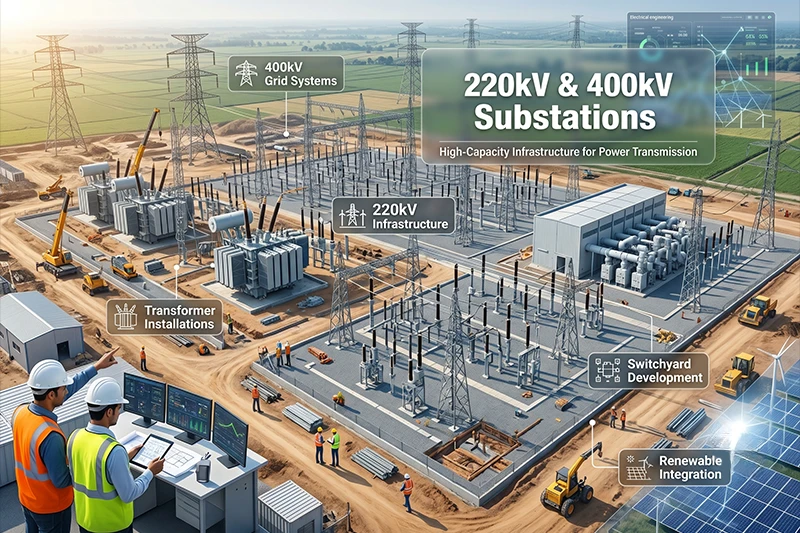
Why High-Voltage Substation Construction is Important in India
India’s pretty ambitious energy goals really do need serious investments in transmission infrastructure, you know, the grid side of things. When new substations come online, they help a lot:
- Strengthen grid reliability.
- Reduce transmission losses.
- Support renewable energy integration.
- Improve power quality.
- Enable industrial and urban development.
- Enhance energy security.
The growing number of transmission projects has really created a strong demand for specialized Electrical Substation Construction services, all over the country.
Power Transmission Substation Contractors in India
When it comes to getting high-voltage projects done on time and with the right quality, the people matter a lot. Usually, it depends on contractors that have strong know-how across engineering, procurement, construction, and commissioning, and they stay consistent during the whole cycle, even when things get a bit tricky.
Role of Power Transmission Substation Contractors
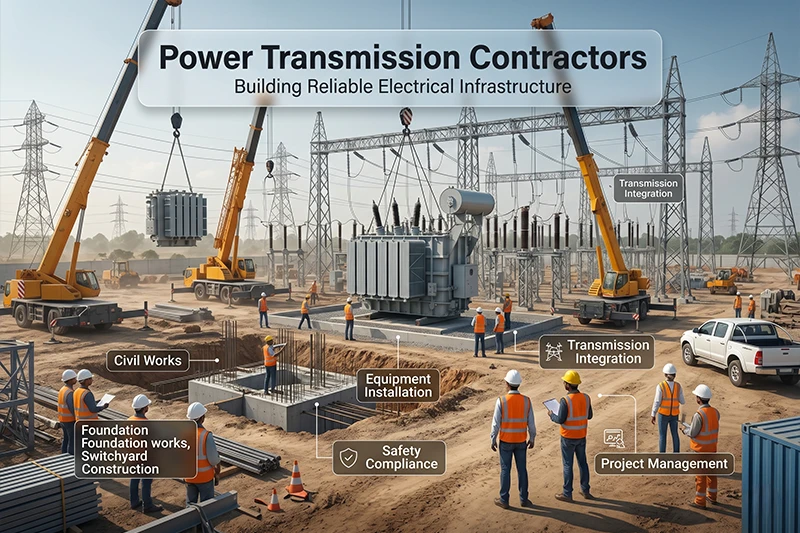
The best contractors handle a mix of tasks, like:
- Preparing the site, and civil works, proper foundations, and layout work.
- Installing electrical apparatus and related components.
- Integrating transmission lines into the yard, switchgear, and control systems.
- Doing testing, then commissioning, and making sure it actually runs.
- Following regulatory requirements, documentation, inspections, and all.
- Managing the project schedule, safety, and coordination.
Organizations like HLK Infra help utility companies, manufacturing units, and government bodies by providing solid transmission and substation infrastructure works. The goal is to produce something that meets national standards, but also the level of standards one might expect internationally, so that when they’re connected, you get a solid piece of grid connection.
Power Substation Construction Process
The Power Substation Construction Process has a bunch of well-timed phases, kind of like you really need them to line up, to keep things safe, efficient, and still reliable for the long run.
- Project planning and feasibility – The project starts with some basic steps, such as
- Load assessment
- Site selection
- Environmental studies
- Grid connectivity analysis
- Cost estimation
When the planning is done right, it is much easier to catch the technical details and regulatory rules before any actual construction starts, or later becomes messy.
- Engineering and design – In engineering and design, the team goes through detailed work, such as:
- Electrical system design
- Switchyard layout planning
- Grounding system design
- Protection and control schemes
- Structural and civil engineering
At this moment, the project blueprint is basically locked in, and it becomes the plan for procurement and the construction effort.
3. Procurement of equipment – For the equipment, the major purchases usually cover:
- Power transformers,
- Circuit breakers
- Isolators
- Current transformers
- Potential transformers
- Control panels
- Protection systems
- Busbars and conductors
Good procurement matters a lot, because it supports day-to-day operations and reduces maintenance headaches that show up later.
- Civil construction – Civil construction is usually about the groundwork and the physical build, for example:
- Land development
- Equipment foundations
- Control room construction
- Cable trenches
- Internal roads
- Drainage systems
So this stage forms the actual infrastructure where the electrical installations will later sit and connect.
- Electrical installation – Electrical installation includes activities like:
- Transformer erection
- Switchgear installation
- Busbar assembly
- Cable laying
- Protection system installation
- SCADA integration
This is one of the most critical parts of the entire construction path, not just “important”, but really decisive.
- Testing and commissioning – Before the site is energized, comprehensive testing happens to verify:
- Equipment performance
- Protection system functionality
- Grounding effectiveness
- Safety compliance
After they’ve finished, and every test checks out, the substation comes in service, it is slowly plugged into the electricity network so that it can slowly be brought safely back online.
EPC Scope for Substation Build Projects
Now, on EPC for substation construction, when EPC stands for Engineering, Procurement, Construction, all these three things come under an EPC scope; you would typically expect EPC scope to cover these entire aspects under an EPC contract, you know, so everything you kind of bind them together under one contract, and you know there’s no jumping around with multiple contractors that way.
- Engineering – In the engineering phase, there are several parts, such as system studies, detailed design, layout preparation, equipment specification, and protection coordination studies.
- Procurement – The procurement activities include vendor selection, material sourcing, equipment inspection, and logistics management
- Construction – Construction responsibilities generally cover civil works, electrical installation, mechanical erection, site supervision, testing, and Commissioning
- EPC contractor– The EPC contractor also conducts equipment testing, system integration, performance verification, and final commissioning
Overall, when the same EPC team manages the whole lifecycle, from studies through the last handover, EPC execution helps cut down coordination hurdles and makes accountability clearer.
Typical Timeline for High-Voltage Substation Construction
Even though the timelines can change a bit depending on how big and complex the project is, a typical high voltage electrical substation project might kind of run on something like this schedule:
| Project Phase | Estimated Duration |
| Feasibility & Planning | 1–3 Months |
| Engineering & Design | 2–4 Months |
| Procurement | 3–6 Months |
| Civil Construction | 4–8 Months |
| Equipment Installation | 3–6 Months |
| Testing & Commissioning | 1–2 Months |
Overall project timelines usually sit somewhere around 12 to 24 months; really, it depends on the voltage level, the site conditions, and how the regulatory approvals play out.
Conclusion
India’s growing power sector relies heavily on high-voltage substations to maintain smooth electricity flow and ensure overall grid stability. For a successful high-voltage substation construction India-type project, you usually need expert engineering, plus procurement, construction, testing, and commissioning, all done in the right way. With Substation EPC Services in India, Electrical Infrastructure EPC Services, and also Turnkey Substation Projects India, organizations like HLK Infra help push forward efficient, resilient, and future-ready electricity infrastructure across the nation.
Read More – How to Read and Evaluate an EPC Contract in India
Questions People Frequently Ask
A high-voltage substation is an apparatus used in changing, regulating, and distributing electrical power at the voltage level for transmission lines.
High-voltage substation projects often take 12 to 24 months, depending on voltage and difficulty level.
Substation EPC Services means that engineering, procurement, and construction, testing, and commissioning are executed in one package.
Turnkey projects can save project owners considerable time and project management hassle by providing one point of responsibility and quicker timelines.
We can also see it in long-distance power transmission, the integration of renewable energy, etc. It can satisfy the demand for power on the side of industry.