

In India, the data centre construction boom in 2026 is driven by Artificial Intelligence, cloud services, and digital technologies. Some of the challenges that developers must address are power reliability issues while balancing sustainability engineering, procurement, and construction methods, smart building technologies, and intelligent infrastructure systems. HLK Infra provides India with reliable data centre infrastructure solutions that operate efficiently and scale to future needs.
Introduction
India is becoming a global center for digital infrastructure, and data center construction in the country is increasing at an unmatched speed. The country experiences extensive Data Center Infrastructure growth because artificial intelligence (AI) and cloud computing, together with data localisation policies and increasing internet usage, create new demand. By the end of 2026, India will have more than 2 GW of installed capacity, which will increase to over 8 GW by 2030 according to long-term forecasts.
To start construction in 2026, developers, investors, and data center EPC contractors need to gain comprehensive knowledge about regulatory frameworks, power supply options, and sustainability requirements, and advanced building methods.
The Data Centre Boom: Why 2026 Is a Turning Point
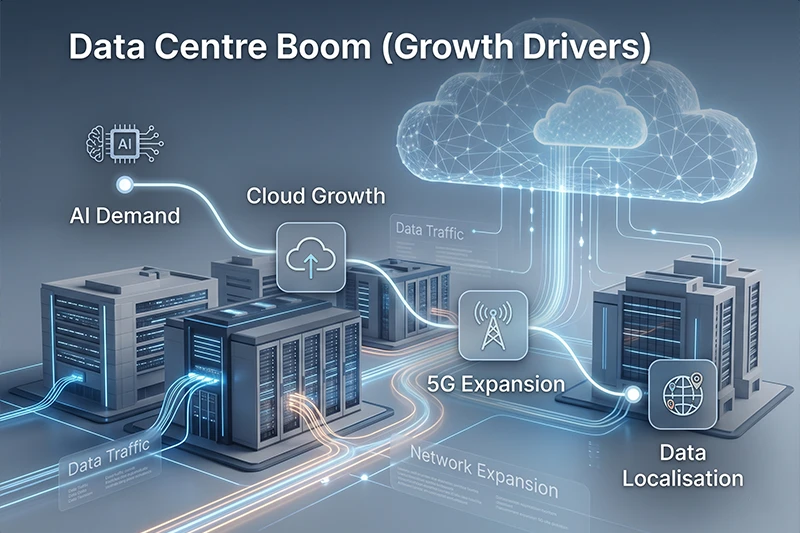
India’s data centre industry experiences unprecedented growth, which currently establishes new records for expansion. The installed capacity has grown almost three times its 2020 level, and the system will achieve a capacity range of 4.5 GW to 6.5 GW or even more by 2030. The total project value already exceeds $95 billion, and it will surpass $100 billion by 2027.
The key demand factors that drive this expansion:
- Organizations increasingly implement cloud services
- AI workload demands show exponential growth
- 5G network implementation begins
- Governments enforce data storage requirements
The magnitude of this expansion shows itself through recent events. India establishes itself as a worldwide digital infrastructure center through the announcement of major hyperscale projects, which include multi-billion-dollar AI data centers. The Digital Personal Data Protection (DPDP) Act 2023, together with the Reserve Bank of India data localisation rule for payment data, has created a requirement for domestic data centre infrastructure to become an essential national resource.
India produces almost 20 percent of worldwide data, yet maintains only 1.2 percent of total global data center capacity, which creates an opportunity for developers who seek to build high-tech facilities.
What Developers Must Consider Before Starting Data Centre Break Ground
Here is a brief explanation of the main elements that determine advanced technology facilities in India and the necessary prerequisites for project initiation:
1.Site Selection and Location Strategy
Site selection stands as the most crucial choice that affects the results in all data center construction projects. The first standard, which needs to be satisfied, requires a system to maintain complete operational power throughout the day without any interruptions because any brief power outage will create data loss, which leads to violations of service-level agreements (SLAs) that result in major financial penalties.
The developers need to evaluate two factors, which include the availability of water resources to support their cooling systems and the distance that their site needs to reach to access both fiber networks and subsea cable landing stations, while they also need to assess climate risk profiles, which include flooding, seismic activity, and heat stress, and they need to evaluate their future expansion needs.
Around 72% of Indian districts face severe flooding, which makes it essential for climate resilience assessments to be conducted in these regions. The data center hubs in Mumbai, Chennai, Hyderabad, Bengaluru, and Delhi-NCR provide businesses with excellent access to networks and essential facilities, yet they face challenges because of their limited land resources and intense competition for essential assets. The state policies of Andhra Pradesh, Rajasthan, and Odisha enable these emerging markets to attract attention because they provide various state-based advantages and land resources.
2. Power Infrastructure and Energy Strategy
Electricity expenses contribute 60 to 70 percent of all operational expenses for data centres. Developers need to create power systems that require backup power solutions that include grid connections, diesel generators, uninterruptible power systems, and modern battery energy storage systems.
The data centre sector in India is at an inflection point on renewable energy. Renewable energy developers can achieve technical feasibility for an 80 percent renewable energy supply through solar-wind systems, which use battery storage and geographically diverse solar-wind resources. The project risk increases because regulatory friction exists through inconsistent banking rules, high cross-subsidy surcharges, and different state policies.
Developers must collaborate with discoms and open-access renewable energy developers to establish permanent power solutions, which they need to develop before they start building their projects.
3.Water Usage and Cooling Technology Decisions
Data centres incur their highest capital and operational expenses through their cooling infrastructure system. The energy requirements of traditional air-cooled systems reach high levels, while water-cooled systems operate with better efficiency but need large quantities of water, which results in a typical 100 MW hyperscale facility consuming around 2 million litres of water each day.
The increasing demand for power through AI processes makes advanced cooling systems like direct-to-chip cooling, dielectric plate cooling, and immersion cooling more essential. Furthermore, technologies take time to reach mainstream use because their expenses and supply chain problems make them hard to adopt. However, these technologies provide essential benefits for India’s cities, which experience water shortages, because they cut down on water and electricity consumption.
HLK Infra provides smart building engineering services together with smart building solutions, which enable data center infrastructure designers to implement advanced cooling systems from their initial design stage through their entire operational lifecycle while achieving energy efficiency, regulatory compliance, and enduring operational excellence.
4.Regulatory and Policy Navigation
India currently lacks a binding national data centre policy, though the Union Budget 2026 announced a significant long-term tax holiday extending to 2047 for data centre and cloud investments. The state governments are currently developing policies, while 15 states have established their own data centre regulations or related IT/industrial policies.
Developers must evaluate state-specific incentives, which include electricity duty exemptions, stamp duty waivers, concessional land allotment, capital subsidies, and single-window clearances.
Stakeholders have identified that single-window systems do not effectively reduce operational delays because they face difficulties with land acquisition and grid connectivity approvals, building plan sanctions, and fire NOCs. The project requires early regulatory engagement together with experienced data center EPC contractors to prevent any delays in project timelines.
5.Sustainability and Future-Proofing
The world is experiencing stricter regulatory measures, which require both energy and water usage data to be reported by data centres that operate at 500 kW or higher, according to the EU Energy Efficiency Directive. Only 5 of India’s 15 state data centre policies currently include explicit sustainability provisions.
The developers who implement sustainability practices into their projects from their initial design stage will achieve better results in both meeting legal requirements and maintaining their business operations for an extended period.
Developers who use HLK Infra’s smart infrastructure solutions together with its data centre infrastructure expertise can create advanced technology facilities that fulfill present performance requirements and achieve future sustainability standards.
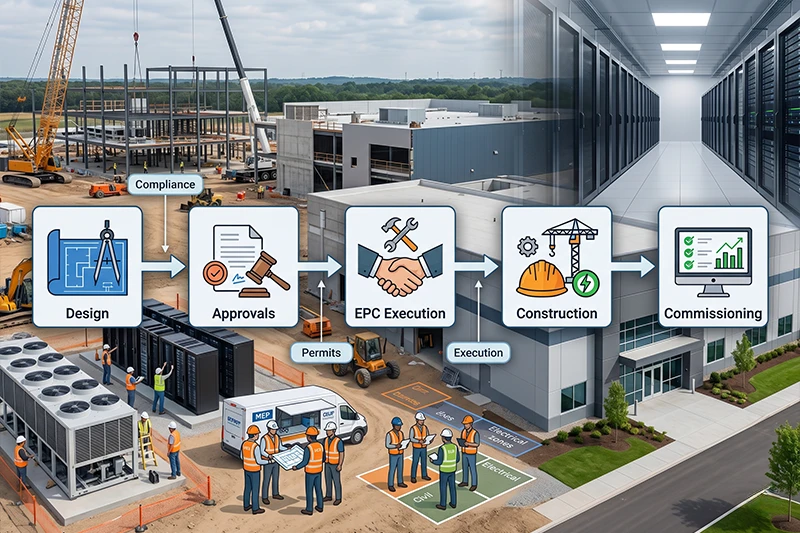
Role of EPC Contractors in Data Centre Projects
The success of a project depends on selecting an appropriate data center EPC contractor from the available options in India. The Engineering Procurement and Construction partners execute the project smoothly from initial design work until final commissioning.
The experienced EPC contractor delivers
- End-to-end project management
- Expertise in mission-critical infrastructure
- Faster time-to-market
- Cost optimization and risk mitigations
HLK Infra has established itself as a reputable company that delivers state-of-the-art technological facilities throughout India with its complete EPC services designed specifically for data centre development. HLK Infra helps developers construct infrastructure that meets future requirements through its commitment to quality, efficiency, and scalability.
Conclusion
India is experiencing a data centre construction boom that will last for ten years because artificial intelligence, digital technology, regulatory requirements, and international investment patterns are driving this movement. Developers who choose to act with the ideal location, power solution, and cooling system, and EPC collaboration will achieve significant results from their efforts.
HLK Infra is dedicated to assisting developers throughout their work by providing support from the initial feasibility assessment to the intelligent infrastructure design phase and finally to the construction of advanced data center facilities throughout India.
For data centre construction, smart building engineering, and advanced technology facilities, you can reach out to HLK Infra through their contact channels.
Questions People Frequently Ask
Mumbai leads India’s data centre market with approximately 25% of operational capacity, which shows that Chennai, Hyderabad, Bengaluru, and Delhi-NCR follow as the next largest data centre markets. The emerging data centre markets in Andhra Pradesh, Rajasthan, and Odisha provide businesses with both policy advantages and suitable development sites.
Each state demonstrates distinct approval timelines that differ throughout the state. The system of single-window clearance does not eliminate the lengthy approval process because it applies to land acquisition and grid connectivity, building plans, and fire NOCs. The process of overcoming these obstacles becomes easier when data center EPC contractor HLK Infra gets involved at the beginning of the project.
Air-cooling systems show reduced performance in India because of its constant high temperatures and humidity conditions. The more commonly used cooling systems include water-cooled and hybrid systems. Direct-to-chip cooling systems and immersion cooling systems have become the preferred choice for AI-dense facilities that require high power densities. HLK Infra develops smart building solutions that include foundation-level advanced cooling design systems.
Data centers need a power supply system that consists of grid electricity from discoms and backup DG sets, UPS systems, and battery energy storage systems (BESS) that work together with open-access renewable energy purchase. The process requires companies to work with state power authorities at the beginning while creating their systems with built-in backup features.
HLK Infra provides extensive knowledge through its smart building design work, its development of intelligent infrastructure systems, and its construction of high-tech research facilities. Developers who want to create advanced data centers in India can use HLK Infra’s comprehensive services, which include MEP design integration, cooling system development, energy management, and smart building system installation.